Sunday, September 22, 2013

Sorry delegates, you may have to put in a full day on Tuesday...

This week the new president of Iran, Hasan Rouhani, will address the UN General Assembly and it looks like delegates may not be able to go and pick up their kids from school/have an early afternoon round of golf/hit the pubs for happy hour, like during the Ahmedinejad-days.  Rouhani has stated that he has “full power and complete authority” in negotiations of Iran’s nuclear program and made several goodwill gestures that could suggest that he may have the kind of influence needed for change within the Iranian government.
Rouhani, who ran as a moderate and attracted the backing of supporters of the 2009 Green Movement, ran on a platform of improving Iran’s economic situation, international relations and improving civil liberties, which ultimately won him the election by a clear majority.  So far, Rouhani has been saying all the right things and appointing the “right” candidates (based on how much his choices were attacked by conservatives in Iran) into key cabinet positions, which would make the West hopeful for progress on the nuclear issue.  The main problem with all of this is that matters of national security (i.e. energy policy/uranium enrichment) fall under the power of Ayatollah Ali Khamenei.  Therefor western analysts are skeptical that Rouhani’s election is going to turn the nuclear dispute around – but what if Khamenei is turning around (slowly)?

In the run up to his trip to New York, Rouhani has made several gestures that show that he may be serious about making progress or even resolving the nuclear issue.  On 9/18 Iran released 11 of its most prominent political prisoners without much of a notice; furthermore the op-ed in the Washington Post and the recent NBC interview with Ann Curry, were much more carefully thought out and constructive than any utterings of his predecessor.  The interview with Ann Curry was not ground breaking by any means and Rouhani’s answers were often as evasive as the ones we are used to from our politicians.  But Rouhani made clear that Iran wants to continue peaceful enrichment of uranium within their rights in the NPT and under supervision of the IAEA.  Furthermore, Rouhani stated that he was given fexibility in negotiations by Khamenei.  Obviously, that alone is not going to convince anyone, but it certainly looks like more influence than Ahmedinejad had on Khamenei.
Rouhani’s advantage in domestic politics is that he has a relationship with Khamenei dating back to the Revolution, as well as links to the military from his time as Air Force commander during the Iran-Iraq war.  Rouhani was also top negotiator during Khatami’s presidency, where Iran agreed several times to suspend enrichment activities voluntarily.  Furthermore, Rouhani is also backed by former president Akbar Hashemi Rafsanjani, who is chairman of the Expediency Discernment Council and the richest man in Iran.  Rafsanjani is a long-time rival of Khamenei and has considerable clout within the political system and parts of the military.  While Rafsanjani lost some political ground recently, like being barred from the 2013 election, he could be a key figure in the future.  

The West has stepped up its sanctions against Iran considerably, which has decreased its oil production to merely 1mm barrels/day, the main source of income for the government and ultimately the Revolutionary guard.  If sanctions are “biting” as much as we are told, and Khamenei’s funding sources for the revolutionary guard are starting to come under stress, he may be more concerned about avoiding a domestic power shift, than giving into a nuclear deal. 
Granting more civil liberties, freeing political prisoners, agreeing to a nuclear deal would strengthen Rouhani’s position domestically, and arguably Khamenei’s.  The better off people in Iran are economically and socially, the less they would be inclined towards regime change, something that should worry the political elite in Iran, especially after the 2009 elections, the Arab Spring and recent events in the region.  Khamenei may be a strong supporter of Assad’s regime, but one would hope that if he has the choice between stability at home (especially of his own position) and supporting a dictator that is destroying his own country, he would chose the former and same goes for a deal on the nuclear program.

It will be interesting to see if there will be an actual rapprochement between the U.S. and Iran (Rouhani is scheduled to meet Francois Holland at the U.N. this week) beyond going through the motions of yet another set of fruitless negotiations. It is certainly looking better than it has in the last few years.

Friday, September 20, 2013

Russian Statecraft vs. Obama Administration: Russia 1, Obama 0?


"Definition: statecraft--noun 1.
the art of conducting state affairs; statesmanship."

As defined by Webster's 11th edition, statecraft sounds rather clear and straightforward;  unfortunately, the same cannot be said of the Obama administration's recent handling of the Syrian crisis.  In fact, President Obama's attempts to get a handle on the political, military, and humanitarian crisis in the middle east seem utterly laughable for someone who recently compared himself to Ghandi and Nelson Mandela; rather than being a grand statesman in the vein of Abraham Lincoln (to whom Obama likens himself quite frequently, going to far as to swear into his second term on Lincoln's Bible), he cannot even persuade his own party to authorize action to enforce his much-publicized "Red Line" (which he now claims not to have set) on Syrian chemical weapons use.
 
Ponder over the waffling of the leader of the free world, as we compare the President's course of inaction to Putin's regime in Russia.  While the American Secretary of State John Kerry was seeking international help in finding definite proof about the use of chemical weapons in Syria (which the UN has now provided), Russians were sent out directly to analyze the incident (free from the constraints of the international bickering of the UN), and has offered solid proof supporting its own interpretation on the Syrian mishap.  The Obama administration has been advocating both for a unilateral strike on Syria and trying to get international support for the same, presenting mixed messages for all audiences.  The irony of Obama's similarity to former President Bush in this position is rather plainly seen on the world stage, and the world has paid attention--intending not to be sidelined the same way as it was during the previous administration. Russia, meanwhile, has been the foremost advocate of following the international norms that the Obama administration claims it is pursuing--going so far as to have Putin write an op-ed article in the New York Times cautioning against "American Exceptionalism," while advocating for a very clear, determined, directed course of action.  Putin has also jumped on the recent off-the-cuff remark by Kerry indicating that military intervention could be averted if Assad turned his ABC-type weapons over to an international coalition.  This has resulted in the entire world recognizing that Russia is "gaining clout" on the world stage for preventing an unjust escalation of the Syrian civil war.  No waffling on that one.
 
Why does this really matter to Americans, and to our National Security as a whole?  While the Obama administration and Secretary of State Kerry have been telling the world that the Syria deal is an "isolated incident" and portends nothing about future American actions (specifically against Iran), this could not be further from the truth.  Kerry is on record as saying that "[the United States] cannot have hollow words in the conduct of international affairs, because that affects all other issues," international affairs have recognized that Obama's "Red Line" speech ultimately meant nothing.  While the immediate security question is Iran, the implications can be the same for Obama's stance in Egypt, Greece, the Eurozone, or basically any area where the United States has set forth other "Red Lines" and hard policy directives.
 
During his original presidential campaign, Obama said that "This president may occupy the White House, but for the last [several] years the position of leader of the free the world has remained open, and it's time to fill that role once more."   It is certainly an interesting security development that the "leader of the free world" at the moment does not appear to be President Obama, but instead seems to be an ex-KGB agent who is striving to top Stalin in Russian history.
 
The image below can sum it up quite nicely, albeit in only the manner of a trite internet meme:
 

Thursday, September 19, 2013

"The Dark Vein of Intolerance": America's Majority-Minority Future & the Face of Insider Threats

Miss USA 2013, is Nina Davuluri, Miss. New York, a South Asian-American woman. So what does Miss. America have to do with National Security? 
The public reaction to a Brown-Skinned, hyphenated-American being the face of Miss. America is an example of the social cleavage that exists between American interests and the perceptions of American identity. The consequence of this cleavage results in micro-aggressive racist policy making when it comes to protecting national interests in the intelligence community. The recent training program developed by the Defense Information Systems Agency on identifying "Insider Threats" is an example of how race, gender, national origin, ethnicity, economic status and sexuality are all factors of training prejudice rather than awareness or appreciation for the identities that make up the face of America. One should not be surprised to hear this. Just 50 years ago Black and White College aged students that participated in the Freedom Rides were on the FBI watchlist for being suspicious and challenging the law of the land of separate but equal. The rage, anger, racist, xenophobic remarks by prominent and everyday Americans on social media outlets toward Miss. America 2013 is evidence of how when people think of Miss. America, a South-Asian American woman’s face is not the image that first, if ever, that comes to mind. A similar racist lashing was dealt in 2010 when Miss. America was of Lebanese ethnic-origin and social media/news outlets were quick to link her with Hezbollah. Novelist Toni Morrison, Presidential Medal of Freedom recipient states: “In this country American means White. Everyone else has to hyphenate.”  

Domestic policies project on how intelligence and foreign policy initiatives are carried out, this is not a new concept. Domestic policies on how Americans in positions of power, elected or appointed, view other Americans, in relation to this blog post, Americans of color, is best described in the words of former Secretary of State and Joint Chief of Staff, Colin Powell, the view comes from "A Dark Vein of Intolerance". Although Powell speaks of this vein in reference to a political party, the larger message is that it is a dark vein that runs in our country's view towards minorities. Minorities as being lazy, not legitimate, i.e. the birther movement. This dark vein runs from political party campaigns and into national security training. 

One of the insider threat training slides developed by DISA is featured below:


Hema, is a South-Asian American who visits family in India, speaks openly of unhappiness with US Foreign Policy and had her car repossessed while at work. So she cares about her loved-ones, takes pride in using her first amendment rights and has a bad financial situation and therefore she is a "High-Risk" threat to National Security according to this training slide. In the next fifty years, the United States will be a majority-minority country. In the year 2012 more biracial and minority children were born in the US than white children. Americans and their understanding of the American identity needs a dialogue on diversity. A dialogue that is not afraid to look back at a history of marginalizing Americans as second-class citizens or subjects of suspicion based on the facets of their identity: Alien Sedition Act, Japanese Internment, Excluding religious minorities from the Armed Service because of their respective articles of faith, jailing dissidents like Congressman John Lewis, a student freedom-rider who was unhappy with segregationist policies and laws.

The term national interests is used sloppily in the media by speakers on popular news channels, poorly defined and the underlying biases left without much examination or scrutiny. However, US government agencies should not sloppily define insider threats that threaten national security interests to protect intelligence. This is training in prejudice, not national security and it is damaging for our majority-minority future. Americans of all backgrounds are paying attention. Instead of fostering appreciation and understanding of differences in all American minority ethnic/racial/sexual orientation identities, this training fosters paranoia and suspicion and feeds into incorrigible pessimistic tendencies. Tendencies that are not even proven to be effective. Freedom and liberty for all, is a national interest, an interest highlighted in our pledge of allegiance and thus the freedoms to be different and ethnic and of immigrant background should not infringe on your liberty to be treated equally in the workplace especially in the federal government. One's identity should not be the basis of suspicion, or any unjust, unproven prejudice and is another form of racial profiling.

Meanwhile the Police Commissioner of the NYPD just issued a memorandum clarifying that Indian-American and American-Indian are two different respective identities. In an effort to get the NYPD to correctly collect demographic data on incidents. In a country where one of the most prominent police agencies, NYPD, cannot distinguish between an Indian-American and American-Indian, it should be an indicator for federal defense agencies to refrain from profiling and rather stress on educating its workforce on the minority, or in this case, women of color in the intelligence community.


This training dismisses the leadership and voice of Americans who have voted for South-Asian American women in politics, Women that may look like and be like “Hema”. 


Harmeet Dhillon- San Francisco Republican Party Chairwoman


Governor Nikki Randhawa Haley South Carolina 


Tulsi Gabbard Congresswoman Haiwaii 

It dismisses that America is a country made of immigrants and a country with a changing face. It dismisses an outlook of domestic stability and peace where diverse groups of people from different national origins and ethnic backgrounds live in peace while actively participating in the world's oldest constitutional democracy. It dismisses America's own post-Colonial legacy and legacy of migration: forced or willing. We need a dialogue on how we can further expand equality of opportunity and rid of barriers to entry for marginalized Americans instead of treating fellow Americans as “insider-threats” simply because of their identity, especially a hyphenated-identity. This train of thought is elementary and unsophisticated and no different than the people on social media who called this year’s Miss. America,: “Miss. 9/11” and asked “When will a real American ever win this pageant again?” This technique and training program under the current administration, undermines all the struggles for social equality and justice to an oversimplified and poor solution to serious concerns: protecting our nations most vital secrets and intelligence.

Rather than training on unproven notions of identifying an "insider threat" by portraying women of color as the "insider threat", we need better scientific consensus and investigation when it comes to profiling who is an insider threat, and not on the basis of their disagreement with their own country's policies combined with their racial or immigrant background. 

Monday, September 16, 2013

Commitment to Deterrence


“If commitments could be undone by declaration they would be worthless in the first place.” – Thomas Schelling

So far, President Obama’s declaration of a “red line” against Syria has proved mostly ineffective.  Why did he publicly state his “red line” against Syria’s use of chemical weapons?  He was asked a question and he had to answer, but (being a politician) he would have had to realize the consequences of his statement.  At the time, whether he knew it or not, he was attempting to use deterrence, which, unfortunately, did not work.  Now he’s created a conundrum for himself that could ultimately make him look weak to countries such as Iran, North Korea, and China. 

In Thomas Schelling’s Arms and Influence he writes on deterrence, coercive violence, compellence, and interdependence of commitments.  While it seems likely that Syria will hand over their chemical weapons (thanks to the diplomatic efforts of Russia) without suffering a military strike from the United States, what affect does this have on President Obama’s use of deterrence against other countries?  Since President Obama created and clearly communicated his “red line” on Syria’s use of chemical weapons and has failed to make good on his promise to take a stand against Assad’s use of them on his own people, how can the President not look weak to the international community? 

He doesn’t seem to be helping himself, either.  On September 4th he said that he didn’t set a red line against Syria.  Rather, he was speaking for the world.  While that may be true and while the entire world probably agreed with what he said, he is still the President of the United States.  Even if he originally said a “red line for us” and used “us” when speaking at that White House press conference in 2012, he can’t retract his statement and dismiss its significance by saying he was speaking for everyone.  

It would not be wise to think that President Obama’s inaction on his own “red line” will not affect his deterrence efforts elsewhere in the world.  While some in the international community may recognize that the United States should not get involved in another conflict in the Middle East and that it is in President Obama’s favor that Syria seems to be willing to hand over their chemical weapons, to think that other countries he has threatened will still hold his threats as credible could be mirror-imaging on the part of the United States.  We hope and believe that President Obama would make good on his threats against North Korea and Iran, but will they believe his promises to be true in light of Syria?

Schelling writes that the reason we commit ourselves to certain things is because our commitments are interdependent.  Therefore, if we back out of a commitment we made against Syria’s use of chemical weapons, it directly affects our commitment against Iran (interdependence of commitments). 

Since President Obama’s “red line” against Syria hasn’t worked out for him so far, his comments towards Iran are interesting.  This past weekend he said, “My suspicion is that theIranians recognize they shouldn’t draw a lesson that we haven’t struck [Syria]to think we won’t strike Iran…I think what the Iranians understand is that thenuclear issue is a far larger issue for us than the chemical-weapons issue,that the threat against Israel, that a nuclear Iran poses, is much closer toour core interests.”  The world understood that President Obama would act if Syria used chemical weapons and it looks like they were wrong about that.  So could he be wrong about this? 

While I sincerely hope that President Obama is correct and that the Iranians really are analyzing this Syrian situation the way that the President thinks they’re analyzing the situation, could this just be his attempt at saving face?  As Americans, we want to see our President succeed, especially in his foreign policy.  President Obama set the stage and waited on Assad.  A deterrent threat is supposed to change the consequences if the act in question (the use of chemical weapons) is taken.  Assad was not stopped by deterrence and no action was taken against him.  Even if our inaction might be justified, only time will tell just how serious our commitments will be taken in the future.             

In conclusion, the President would do well to read Schelling’s book, as it might offer insight into how he should approach threats in the future. 

Saturday, September 14, 2013

Obama’s Multi-Stage Syria Strategy: An Educated Guess


The deal reached by the US and Russia to remove chemical weapons from Syria in lieu of airstrikes seems to be the latest stage in the strategy created by President Obama to deal with the unique constraints on his ability to act on this latest Middle East flareup.

With the US still winding down its commitments in Iraq and Afghanistan after more than a decade of punishing conflict, and with over 50,000 troops still in place, neither the President nor the American people have much appetite for another armed intervention in the absence of an obvious existential threat; a Pew poll last week found only 29% of respondents in favor of the limited step of airstrikes against Assad.

Add to this reluctance the additional domestic constraints of a growing public suspicion of the abuse of Presidential power in the use of force overseas and an obstructionist Congress that probably won’t be able to pass a bill continuing to fund the federal government, much less muster any sort support for a military action, and President Obama is presented with an extremely narrow set of options for acting against a legacy dictator in an increasingly bloody war.

Faced with these strictures, Obama opted for what historians will probably describe as a nifty bit of political jiu-jitsu: at the end of August, he sought Congressional approval for a military strike against Assad and his forces, simultaneously showing his respect for the Constitution and putting the responsibility for an unpopular military action with a deliberative body that had no real ability to act on that responsibility.

At the same time, Obama found a way to weaken the Assad regime, appear to be honoring international conventions against chemical weapons, and neutralize frenemy Russia’s opposition to American intervention, all while providing himself with enough plausible deniability should the plan fail: by having Secretary of State John Kerry “inadvertently” suggest having the international community take control of Syria’s chemical weapons as the only way of deterring a US military assault, he provided Russia and Syria, as well as the US, with a route away from a military action that would only make things more difficult for all parties involved, morally satisfying though it might seem.


The result is that, as Professor Farley notes, the US has “sold” the Syrian chemical weapons problem to Syria while militarily weakening the Assad regime. Add to this the report that the CIA has finally started delivering arms to Syrian rebels, and you have the culmination of the middle stages of a strategy that, while it may not look familiar as a traditional American armed response, is realistically the only one Obama is left with as a way of eventually removing Assad from power.

Thursday, December 13, 2012

Assad's waning power


Things are not looking good for Bashar al-Assad.

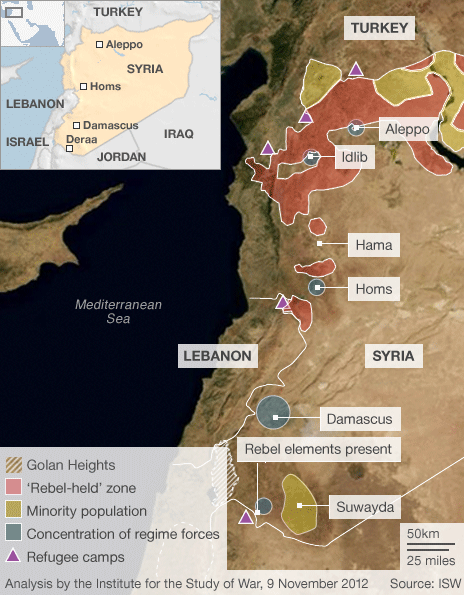
He has consistently lost control of his country, piece by piece. He has pulled his forces back in an effort to concentrate defenses of Damascus and other key cities. This tightening up also makes it easier to feed and provide fuel for the forces that stay loyal to him. While tactically this makes sense—warm and well-fed soldiers do tend to feel better about continuing the fight—it will most likely not work out for him in the long run. Estimations have Assad running out of money completely by April at the latest. The U.S. recently recognized some of the Syrian rebel forces, and now Russia has admitted that a collapse of Assad's regime is likely. A bleak outlook indeed for Mr. Assad.

While this is important progress for the country, they are certainly not out of the woods yet. Assad has proclaimed that he will “live and die in Syria,” and has given no indication of giving up the fight any time soon. Quite the opposite, in fact. There have been recent (not completely verified) reports about Assad’s forces firing Soviet-era Scud ballistic missiles against the rebel forces. This is a marked escalation in the level of violence Assad has been willing to inflict upon his opponents.

While reports that these Scud missiles are still being verified, the international community does believe that the Syrian government has made preparations for the deployment of chemical weapons. The U.S. and other Western nations have warned Assad not to deploy these weapons, and he has made all the proper assurances that he won’t. However, why mobilize them if he has no intention of allowing their use?

Assad is getting more and more desperate daily. It is not unthinkable that he would deploy these weapons if he felt he had no other choice, especially if the reports of Scud missile attacks are true. It is a well-known phenomenon that animals are at their most dangerous when cornered and people are no different. If Assad isn’t feeling cornered yet, it is certainly only a matter of time. 

There have been calls for the U.S. to step up its intervention in this conflict in the hopes of averting any more escalation in violence. More than 40,000 civilians have already been killed and countless more have been displaced during this nearly two-year conflict. Is it now time for the U.S. to intervene directly or should we continue to let this play out?

Why Mourn Monti?

New Leadership is in Italy's best interests, and America's


The Atlantic has seemed suspiciously quiet lately. Greek disaster was (temporarily) averted, while issues closer to home have grabbed our attention as we brace for Thelma (Barack Obama) and Louise (John Boehner) to drive their car (the United States of America) over a cliff (of the fiscal variety) rather than get in trouble with the cops (ideological crazies on both sides.) But the eerie transatlantic quiet is no reason to stop worrying about the European Union. It just means we’re looking for trouble in the wrong places. Sure Ireland is still the bail-out poster child, Portugal is still OK(ish), Greece still hasn’t imploded, and Spain is still making progress. Yet Italy’s election next year may be a make-or-break event for Europe, the ripples of which will not fail to reach American shores. In spite of urgent chatter in leadership circles supporting a new mandate for technocrat Mario Monti, America should hope for center-left candidate Pier Bersani.
                Even by Italian standards, the approaching election is a complex one. Mario Monti, the technocratic Prime Minister who has overseen a unity government since November last year is due to resign early after passage of the 2013 budget. Though Monti has moved to squelch speculation that he may run to renew his mandate, he may yet return to the Chigi. Meanwhile, disgraced former PM Silvio Berlusconi, the ever-present Master of Ceremonies of the Kit Kat Klub of Italian politics, resumed leadership of his People of Liberty Party (PDL), adding to a sense of disarray on the right. Finally, the newly confident and increasingly capable left recently chose center-left Democratic Party (PD) leader, Pier Luigi Bersani, as its candidate amid unexpectedly energetic and enthusiastic turnout.
It has been trendy to support Mario Monti, and, though unlikely, he may renew his mandate. He has stood up well after instituting unpopular reforms, and even under recent withering attacks by Berlusconi’s PDL.  Should the election prove divisive and uncertain, or if the policies of either party appear totally unpalatable to markets, Monti’s supporters may be able to engineer public demand for a renewed mandate.
Despite instituting unpopular reforms and austerity measures, Monti’s government is well-liked. This is mainly due to technocracy; Italians have often looked to technocratic unity governments in a crisis. Monti is extraordinarily well respected in Europe as well, and is credited by Italians and eurocrats alike for instituting one of the more balanced reform/austerity packages, applying a portion of increased tax revenues to stimulative infrastructure investment.

It is supposed that only a technocratic is capable of introducing such reforms in the wildly unpredictable arena of Italian politics. But this is not the case. Much like European markets, European and American leadership are highly risk-averse preferring what they know to what they do not. By that logic, America should desire a Berlusconi victory. After all, he has been intensely pro-America, would avoid military cuts, and may even be able to somewhat ease market fears as a familiar face with familiar small-government rhetoric.
Yet no one wants Berlusconi to return, least of all America. The United States’ first priority is long-term peace and stability on the continent, which requires a strong and democratic Italy. In addition, America’s long-term preferences also include an Italy which views America favorably, is militarily capable, and is a willing military partner. In the short term, American recovery demands stability and growth in Europe. In the medium term, America seeks a reformed Italy with prospects for reasonable growth and that remains loyal to the United States. No potential Prime Minister offers the full package.
Bersani comes closest to fitting the bill. True, his is a former Communist, and represented a the Democrats of the Left, a socialist outfit, in the European Parliament as recently as 2006. That may make markets nervous. But Bersani, a competent former Minister of Economic Development known for market and anti-corruption reforms, is the only credible candidate to reaffirm Italian democratic institutions.
In spite of his Communist past, Bersani conducted  a range of liberalizing reforms as a minister in the Prodi government, and has remained a staunch supporter of the Monti administration. He would likely continue along the path laid out by Monti, lightening heavy regulatory loads and slimming the bloated state. Vague suggestions that investment, especially R&D, should play a greater role might mean a small stimulus sufficient to diminish worries about severe recession without undermining fragile faith in the Italian debt situation.
Most importantly, Bersani would continue these reforms with a democratic, not technocratic, mandate. Another Monti administration would fail to break the perceived tendency in Italian politics to develop crises, institute technocracy, and then return to the dysfunctional system that created the problem. Berlsuconi’s election would only confirm perceptions of Italian politics as theatre of the absurd. Meanwhile, Bersani’s history of corruption-fighting and reformism may make him the Prime Minister to prove that it doesn’t take a technocratic government to create strong policy. Given broad support from center-right to far left, Bersani may have the democratic legitimacy necessary to buck his trade union base. Indeed, coming on the heels of Monti’s tenure, widespread support for centrist reform, and a scattered opposition may finally allow an intellectual center-left PM time to execute a full range of reforms.
Pier Bersani is the best option for both Italy and the United States. Bersani is not the great cheerleader for America that Berlusconi was, but then neither is Monti. And, like Monti, Bersani is also likely to cut military spending against America’s preferences. However, the very low likelihood that America would seek Italian aid in the near future means that a temporary period of marginally anti-American government is tolerable in pursuit of long-term ends.
That is the case today. America needs a stable Europe, and Europe needs a strong Italy. So long as he doesn’t give in to his party’s statist tendencies, Bersani can reassure markets, blunt the effects of recession and boost medium- and long-term growth prospects with targeted investment, reduce chances of EU contagion, and relegitimize Italian democracy. These are all American priorities. It’s a big bill, but Bersani is the only candidate with a chance of achieving it.

Can Morsi pull Egypt together?


Though he has recently rescinded two controversial decrees, Mohamed Morsi’s decision-making style has many Egyptians worried.

The more troubling of these two decrees was a constitutional declaration (made November 22) that essentially gave Morsi supreme power over the country and barred the courts from countering any of decisions. Understandably, the country that had just booted out their previous leader for his dictatorial ways balked at this new development. Widespread public protests and the resignation of eight of Morsi’s advisors led the president to nix that edict last week. 

“Guys, guys. Easy. I said I only wanted to have this power temporarily. I don’t know what everyone was getting so twitchy about, but I’ll give it back now. Gosh.”

Many of Morsi’s former advisors are speaking out about their president’s decision-making process.  While they describe him as open-minded and respectful of all viewpoints, they claim that his final decisions do not reflect their counsel at all. In fact, these former advisors say that they were often surprised by the decisions that the president made. This is particularly irksome to them, and the greater Egyptian population, as Morsi had said that improving the transparency of governmental decision-making was a priority for him.

At the start of his term, it seemed that he was committed to changing how decisions were made during the previous term. In an effort to distinguish himself from Mubarak, he appointed a large presidential team.  He gathered individuals with a wide range of expertise and backgrounds in order to ensure diversity of opinion.

Sadly, this new era of openness seems to have ended. The president may listen attentively to all of his advisors, but it has become clear that real decisions are being made elsewhere. Analysts offer the explanation that perhaps Morsi picked too diverse of panel of advisors. Some suggest that he may be seeking a more streamlined viewpoint (that of the Muslim Brotherhood, specifically) in order to get decisions finalized faster. 

Others argue that Morsi just needs time to adjust to his new role. Admittedly, he is the first democratically elected president in Egypt’s history and has only been in office for five months. Our own presidents struggle to take over power in that time and they aren’t trying to rewrite a constitution at the same time. So, the question now is, as global advocates of democracy, can the U.S. do anything to help ensure this elected leader’s success?

Active Camouflage??? I'm definitely reenlisting!!!


A scene depicting Active Camouflage from the movie Predator 
When it comes to camouflage technology it doesn’t get much better than invisibility.  While most people would dismiss this statement as obvious but technologically impossible, a man named Guy Cramer and his company HyperStealth biotechnology have developed a technology you have to see to believe, which is pretty difficult considering it makes the user nearly invisible.  Cramer, a Canadian national, has been developing camouflage technologies for militaries all over the world for more than a decade.  In 2011, HyperStealth announced a breakthrough in camouflage capability with its Quantum Camouflage material.  Based on photo-optic principles associated with fiber optic technologies, Quantum Camouflage bends ambient light around the user rendering the operator nearly invisible by projecting an image of the users’ background.  Cramer claims this material is lightweight and doesn’t require any sort of electrical power source or special training to effectively operate. 

A demonstration of HyperStealth's Quantum Camouflage technology
Commonly portrayed in popular media as cut-throat in its aggressive efforts to procure applicable cutting-edge technologies, the U.S. Government has proved far less cunning in Mr. Cramer’s experience.  Despite a working relationship with the U.S. military on existing projects and a well established reputation for developing a number of innovative technologies associated specifically with advancing camouflage technology, Cramer claims to have been met with skepticism and a slow bureaucratic process of paper-work and red tape.  Fortunately his priority is not to sell his technology to the highest bidder; rather he has expressed every intention of pursuing a development contract with Canada, the U.S., and the U.K, even if it isn’t the easiest path to choose. 

The situation facing Mr. Cramer should raise some eyebrows about how our government does business.  How many independent innovators have gone to our strategic defense competitors rather than deal with a slow, inefficient process for developing their technologies domestically?  The benefits of Mr. Cramer’s Quantum technology are glaringly obvious even to the layperson and yet he has had to embark on an international publicity campaign to get the attention of the Pentagon.  After a private demonstration with a select group of senior officials from the military Mr. Cramer then faced the painfully slow bureaucratic process of authorizations and agreements between the United States and Canada to gain a military development contract for this technology.  In the meantime, we can only imagine how many foreign governments have now developed a keen interest in Quantum Camouflage not through daring espionage efforts but after seeing this technology displayed on CNN.  If there is anything that should be classified, a light-weight, inexpensive, battery-free material that enables invisibility should be branded top-secret and guarded against theft by foreign interests.

CNN Interview with Guy Cramer and a demonstration of Quantum Camouflage

Hyperstealth Biotechnology Corporation Homepage

Cyber Warfare Cont’d


The last Israel-Hamas war was accompanied by intense online attacks waged by both sides. It started when the actual warfare was going on and became almost non-stop after the ceasefire was announced. Anonymous hackers from both sides used the distributional denial of service (DDOS) attacks to overload the traffic connection to the opponents’ website. The types of DDOS used this time are known as the Layer 7 attacks. They have relatively smaller volume and utilize much less bandwidth, and therefore are even harder to defend against for traditional DDOS scrubbing services. Previously similar attacks have been used for political purposes in Russia-Georgia War and Russia-Estonia crisis. Cyberwar is not new to Hamas-Israeli wars either; there have been a variety of internet attacks in 2008-2009 as well. But the last war still showed several interesting tendencies:
Israeli website defaced by
Pakistani hackers
  • Unlike the previous instances, this time cyber offensives were not launched by only one side of the conflict. Websites of both sides came under regular attacks. For instance, Palestinian group Anonymous started to DDOS Israeli websites few days before the ceasefire and soon came under attack itself. A private U.S. company Cloudflare, which provides website protection services to organizations on both sides of the conflict, found itself in a unique situation observing “crossfire” between the supporters of two sides. Cloudflare CEO Matthew Prince wrote about this in his blog post.
  • Such attacks are not causing physical or any major financial harm to anybody. The maximum DDOS attacks can achieve is paralyzing opponents’ information websites, deterring legitimate visitors from accessing the information. In some cases hackers enjoy posting humiliating photos or posts on the front pages of their victims. So, why making such a big deal out of this? Information campaigns and the ability to justify country’s military actions have been an important part of the warfare from ancient times. Rules always tried to justify their conquests and winners always enjoyed the monopoly over writing the history. In the Internet era, however, losers also get to say and push their version of history. More than that, it is becoming difficult to identify winners and losers. Both Israel and Hamas claim the victory in the last confrontation, boasting their tactical and other successes through social media and other services. After Russia-Georgia ceasefire in 2008, Georgian government also launched an expensive information campaign assuring primarily Georgian society, but also international community, that Georgia has won the war. In these situations attacks on major information services have increasingly symbolic importance.  
  • It was interesting to see that confrontation in the internet space intensified and lasted for days after the ceasefire. In the future this may raise the issue of how ceasefire agreements can and should regulate cyber confrontations as well. Otherwise sides may stop bombing each other’s territory by missiles, but inflict other types of damage in cyberspace. With the technological development this damage can be much more significant than just bringing down the information or governmental websites. However, until attacks are carried out by anonymous individuals and groups unrelated to any official structures, regulating this field will remain very challenging.
  • And finally, to continue on the same note, last Israeli-Gaza cyber conflict again stressed rapidly increasing role of individuals and private companies. Even though the attacks targeted governmental and other official websites, actual “fighting” was happening between individual or groups of unidentified hackers and a private company, that ironically provides protection to both, the Israeli Defense Forces website and the Hamas’ al-Qassam paramilitary wing’s webpage.  

Congress, Arms Sales, and the Middle East


U.S.’s decision to join a group of European and Arab countries in recognizing the legitimacy of Syrian opposition has reopened the issue of whether Washington should also lift the arms embargo and provide lethal support to the Syrian opposition. France has been supporting this idea for a while and Qatar is already providing some weapons to the rebels. However, Victoria Nuland, State Department Spokesperson, has reiterated quite a few times that the U.S. is not going to go beyond non-lethal support. Furthermore, State Department continues to isolate radicals among the opposition – jihadist Al-Nusra Front has been added to the blacklist of foreign terror organizations linked to Al-Qaeda and the Treasury has imposed sanctions against their leaders. It is obvious that the State Department is being extra cautious and is trying to learn from the Libyan experience. According to unspecified sources, during the height of Libyan rebellion U.S. has approved a secret arms transfer through Qatar to Libyan rebels, some of which, according to counterterrorism agencies, ended up in the hands of radical groups. These allegations led several retired military and intelligence officials to speculate that there could have been some links between those secretly transferred weapons and the terrorist attack in Benghazi. 

Administration’s prudence definitely deserves laudation. But the question is how lasting and foresighted this vigilance is. It is not yet clear how long will White House resist the temptation of providing arms to the opposition. And even if it will manage to resist till the end, direct arms transfer is not the only way American arms can reach the rebels. Gulf region is saturated by American weapons, as Washington is obviously not as cautious of signing arms deals worth billions of dollars with various Gulf countries.  

Despite the world economic crisis, global arms sales almost doubled last year and U.S.’s share in 2011 increased to almost 80% of the market. Out of $85.3 billion of global annual trade budget, U.S. received $66.3 billion. Russia remains the second biggest arms provider on the global market, but her share has reduced from 24% in 2010 to only 6% in 2011. Most of these arms went to the developing world. The biggest importer of U.S. arms is Saudi Arabia. It purchased almost half of all U.S.’s arms exports in 2011. Other major importers in the region are the UAE, Iraq, Oman, Qatar, Kuwait, and of course Israel. Most of the arms sold to these countries are described as defensive, aimed at increasing Gulf countries’ defensive capabilities against Iran. But besides the antimissile batteries and missile defense systems, these countries are also procuring vast numbers of F-15 and F-16 fighters, various ammunitions, missiles, and other conventional weapons, which can easily end up in the hands of all groups of Syrian rebels, even if the U.S. is not intending to support them directly.  And this is only the unclassified part of the sales. Foreign countries can acquire American-produced arms through several schemes – Foreign Military Sales (FMS), Direct Commercial Sales (DCS), leases of equipment, transfer of excess defense articles (EDA), and emergency draw-downs of weaponry. In addition to sales, arms are being transferred as a part of the foreign assistance. Almost 12% of total U.S. foreign aid is spent on military. The largest of military assistance programs are Foreign Military Financing, which has been providing funds to Israel, Egypt, and Jordan for purchasing American weapons and in exchange, maintaining peace with each other, International Military Education and Training program, and Counter-drug Aid. The biggest chunks of the arms sales are channeled through the FMS. It includes all inter-governmental deals and is absolutely transparent if the deal is worth more than $14 million. It is administered by Pentagon. DCS however is quicker, sometimes even cheaper route and goes through less governmental scrutiny than FMS. Most of the information about the types and quantities traded are easily classified as “confidential business information.” 

Senator Richard Lugar has criticized Obama Administration for limiting Congressional engagement in foreign arms trade to the very formal procedures. Previous administrations have engaged Congressional leaders in informal discussions of the terms and conditions of all major deals prior to presenting the final agreement for formal Congressional approval. This practice, according to Sen. Lugar, allowed for much deeper scrutiny of the impact of each deal on U.S.’s foreign policy goals in a given country. One of the consequences of the late, rather unilateral decisions, he argues, has been Government Accountability Office’s findings that there are some inconsistencies between the arms sales to the Gulf States and the U.S. foreign policy goals, as defined by the Pentagon and State Department.