Friday, October 31, 2008

Senator (Heinz) Kerry as our next What!?!

Over the past three weeks, Senator John Kerry’s name has popped up as a possibility for the positions of Secretary of Defense and Secretary of State. Allow me to address primarily the first of these positions. WHAT!?! Secretary of Defense Kerry. That sounds like I just heard someone say “Really, we should consider allowing W to hold a third term.” I’m sure that a vast majority of us will agree that the latter of these statements is ludicrous. Allow me to remind you why the former is equally as nuts.

John Kerry once equated the lack of an education to the common American soldier. His exact words went something like this, “if you make an effort to be smart, you can do well, if you don’t, you can get stuck in Iraq.” Maybe you forgot this line…
This coming from a guy who swears he did heroic things in Vietnam. Now I ask you, how could our soldiers, airmen, marines, and sailors look up to a guy like this? How important is it that they can respect him? First, they won’t admire him, and they certainly won’t look to him for support…his words have shown that he will not have them in his best interest. Second, the must respect the Secretary of Defense, and they must have faith that he, the Secretary of the Army, and the President will work well with the Joint Chiefs and the Regional Commanders.

If you believe Senator Kerry’s words hold water, then hold on tight. A recent GAO report shows that the middle and upper classes are over represented in the military. This study shows that those families reporting an annual income of more than $42,040 are overrepresented. Many experts believe that the income of a neighborhood is directly related to the type of education that one would receive in that district. With that being said, our soldiers, many of which come from the middle and upper class, are certainly receiving good educations.

Furthermore, military enlistees outperformed the remainder of the US population on the Armed Forces Qualification test. In a day and age where all anyone wants to talk about is the declining standards of the US military, I hold this statistic up to you in direct contrast to what you’ve been fed by the media…


One can readily see that Kerry was talking out his donkey’s rear when he made his infamous statement - never mind that he made it while soldiers were fighting abroad in a war he voted in favor of…
“Senator John Kerry said Monday that
he would have voted to give the president the authority to
invade Iraq even if he had known all he does now about the
apparent dearth of unconventional weapons
or a close
connection to Al Qaeda.”
(NYT, Aug 04)

Certainly, John Kerry is not the type of man that needs to lead our Armed Forces. Not only does he misunderstand the capabilities and potential of his soldiers, but he also seems to have lost control of his internal monologue in the process. If he can’t watch his tongue when it counts, he may also SUCK as Secretary of State.

Wednesday, October 29, 2008

Fighting the War Within


A recent collaboration of CNN (Anderson Cooper) and MTV placed the veterans returning from the wars in Iraq and Afghanistan in the spotlight. A star-studded line up, including 50 Cent and Ludacris, performed on October 24, 2008 in an event dubbed “A Night for Vets: An MTV Concert for the BRAVE.” Though hundreds of veterans attended the concert, the highly energized affair was intended to be more than just a good time. The concert was an attempt to rally support for the newly proposed Bill of Rights for American Veterans (BRAVE) , a petition organized by MTV and numerous other veterans’ organizations. The bill, though still a work in progress, includes five central points that are aimed at granting US veterans with the rights and respect they deserve. By virtually “signing” the petition, people agree that steps need to be taken to:

1. Properly treat mental health issues
2. Prevent homelessness among veterans
3. Give disabled vets the benefits they've earned
4. Fully fund our veterans' hospitals
5. Compensate troops made to serve longer

It is true that MTV is often associated with mindless teenage dribble, but the recent development of and promotion of BRAVE is commendable. Too often Americans forget to “support our troops” once the troops are safely home. It is necessary to realize that, for many veterans, the effects of war do not cease to exist once the war is over. Veterans often must deal with Post Traumatic Stress Disorder (PTSD), a mental disorder resulting from “terrifying events or ordeals in which grave physical harm occurred or was threatened.” Symptoms of PTSD are insomnia, emotional detachment, haunting memories, and very uneasy nerves. It is not surprising, then, that a new survey conducted by the RAND Corporation reported that approximately 1 in 5 military service members returning from Iraq and Afghanistan will suffer from the disorder. Nonetheless, of those diagnosed with PTSD, barely more than half have sought treatment. It is believed that the lack of funding for the US Department of Veterans Affairs, shortage of qualified psychiatrists, and the stigma associated with admitting a mental disorder hinder several veterans from seeking help.

The consequences of veterans not receiving help for PTSD are enormous. Alcoholism, failed marriages, and thoughts of suicide often result from PTSD. Though no direct correlation has been made with homelessness and PTSD, the fact that 1 in 3 adult homeless males have served their country in the Armed Services is quite convincing that there is some connection. I was very surprised and outraged to learn that there are currently more homeless Vietnam veterans than the total number of American soldiers who died in the Vietnam War.

Surely the men and women who served our country in uniform deserve more respect than to be denied proper treatment of Post Traumatic Stress Disorder. Perhaps money in the defense budget needs to be reallocated to ensure that soldiers are taken care of first and foremost. More psychiatrists need to be trained to deal specifically with PTSD and other mental disorders initiated by the tragedy of war. The military should also attempt to infuse a mentality that assures soldiers that seeking help makes a person strong, not weak or crazy. Though MTV might be onto something positive, it will take a lot more than Ludacris and 50 Cent to ameliorate this dilemma.

Robots to hunt "uncooperative" humans?

The Pentagon is trying to find people to build robots capable of sensing humans and tracking them down in an indoor environment. Some people are concerned that this is just one more stage on the path to eventual robot domination of the world. Or that, at least, it will allow the military/police to further kill innocent people.

On this, I'm with Lewis Page at the Register. Increasing the safety of our own troops, by having one troop control a pack of robots from outside the building, makes it less likely for them to commit mistakes, not more. When the troops life is not at stake, more time can be devoted to making sure that the item being pulled from a small pocket is a cigarette case (or cell phone!), not a gun.

Oh, yeah, that's another big point--these are not "autonomous robot packs" like an initial review would make you think. We are still light-years from computers having anything resembling sentience; a human being still has to operate the robots. (Although I'm not entirely concerned about the day that computers do achieve sentience; "Home is the Hangman" by Roger Zelazny is a great examination of this from science fiction.)

And, what are our alternatives? The current way of dealing with uncooperative humans all too often ends up with us either 1) shooting them or 2) dropping bombs on them. We've talked in class about how terrorist leaders like to use the equivalent of "baby armor" to protect themselves, by surrounding themselves with innocents. Instead of bombing them, taking out the whole compound/apartment building/whatever, this would allow us to send in a squad of robots to fetch just the terrorists. (This is provided this all works AND they are armored well enough to survive a firefight, which is apparently doubtful at the moment.)

My only real concern at this point is how much this will cost. This is a low priority, compared to the Future Combat Systems, apparently, meaning that it could end up being really expensive, funded for a bit, and then dropped. I'm curious to see how this will play out.

Tuesday, October 28, 2008

The US army goes green...in a different way


As reported on by Popular Mechanics this summer, ( http://www.popularmechanics.com/blogs/automotive_news/4217017.html) the US army is currently undergoing production and field trials of the first hybrid vehicle to be widely used the the military. The somewhat in-appropriately named "Aggressor"Alternative Mobility Vehicle (didn't run that past foreign policy image focus groups) is a new diesel electric hybrid that is being proposed as a scouting and ground exploration vehicle. The Army's auto research division, TARDEC, developed the Aggressor with a wide wheelbase for offroad duty, an electric battery dominated engine that tops out at 80 MPH, and a almost non existent thermal signature. The Aggressor also has the added stealth benefit of being able to switch into a "silent running mode".


This is the second generation of the Aggressor, with significant improvement on the battery life and durability of the vehicle. While not at all battle worthy and offering scant protection to its occupants, the army hopes it will be able to fill a general purpose role in quick scouting and stealth missions as well as transportation in safe areas (i.e. on stateside bases). The army is also interested in the long-term reduction of the need for non-renewable fuels.


This is much more of a breakthrough than would appear at first glance. First and foremost, implementation of this new vehicle on a large scale would be a major green move for the army, and hopefully seriously reduce costs. Secondly, as seen with the toothbrush, SPAM, and German shepards, use by the army will often translate back into increased civilian use back in the states. Once released to the public, a sturdy, efficient, powerful hybrid engine could be a major breakthrough. Lastly, to all those nay-sayers pointing out the obvious frailty of the "Aggressor", this also shows that the Army is beginning to understand that big, noticeable, heavy ground vehicles certainly have a place in urban combat and traditional warfare, but there is a need for quick, stealthy, ground vehicles as well (think of Specfor soldiers on horseback in Afghanistan). All in all, the development and proposed use of the "Aggressor" should help to effectively and efficiently fill an important spot in the Army's garage.

The Brilliant Plan to Finance Peace Operations

There are multiple conflicts occurring all over the world today, ranging from the well known Iraq conflict, to lesser known conflicts.  The problem with involving any type of peacekeeping or military force to resolve the conflict is the financial burden the country or organization incurs.  Case in point, the amount of debt the United States has incurred by involving itself in the liberation of the Iraqi people.  This type of financial burden might discourage other organizations and countries from assisting in conflict resolution.  So, how do we fix this problem?  How can we help bring peace to war-torn areas and throw dictators from their positions of power?  The answer lies in the example set by ivory sales in Africa (please note the sarcasm).

The first officially sanction ivory auction in nearly a decade took place in Namibia today, and brought in $1.2 million.  Supposedly all the ivory sold at auction was confiscated in a legal manner, meaning the elephant died of natural causes (technically I guess if the elephant bled to death from a bullet puncturing its flesh, that might be construed by some as a natural death?).  Technicalities aside, proceeds from the auction are going to elephant conservation.  So, wait, they're actually helping the elephants?  Hmm... Could the same be done with confiscated weapons, whether they be handguns or say weapons of mass destruction to help finance peace?  I might just be onto something here.

Great states like the U.S. and other good guys (we wouldn't want untrustworthy states such as North Korea participating), could use all the weapons that were confiscated both within their countries, and from not so law abiding countries, such as Iran, to sell at auction.  The proceeds could then be used to finance peace operations all over the world.  Darfur, DRC, conflicts throughout the Middle East, they could all be solved.  This auction would have multiple benefits.  Not only would it be financing peace operations, but it would give motive to get even more weapons off the street, making everyone a little safer when they go to sleep at night.  This seems like a brilliant plan!

But wait, could there be some flaws to this brilliant plan?  Let's go back to our model, the ivory sales.  Opponents of the ivory sales argue that the legalization of ivory sales will only encourage the poaching and illegal killing of elephants.  They charge that the sales will stimulate, not satisfy, the massive demand for ivory in countries like China.  Now we all know this is just blasphemy, but could there be a negative backlash with the plan to sell confiscated weapons?  Let's examine.

Just for argument's sake, let's say that it might be difficult to monitor who is buying the weapons and to inspect the backgrounds of the buyers, and that maybe, just maybe, they might fall into the wrong hands and come back to bite the good guys in the ass later.  Oh wait, this kind of happened, I think it might be referred to as the Iran-Contra Affair.  Oh crap, this plan may not work.  Well, before we find any other faults, maybe we should just stop analyzing and go ahead with the plan and worry about the consequences later.  We're great at that.

I guess the guys in the ivory sales are doing the same...

Monday, October 27, 2008

Happy Halloween


Anyone wishing to give out a unique candy to trick or treaters (or to quickly get the police called on you by angry parents), should take a look at these chocolate bullets that come in a lovely ammo box style container. 5.56 mm NATO rounds have never tasted more delicioius. http://www.chocolateammo.com/


Friday, October 24, 2008

What has we Awoke?


A recent article found in the Washington Post generates the need to contemplate what has actually been accomplished as a result of the "Awakening." Focusing on the developing political situation in Anbar, the literature numerates the positive military results witnessed recently in the province, but also exposes the potentially alarming socio-political developments which have arisen following the "awakened" anti-insurgent leaders’ empowerment.

In effect, these internal Iraqi groups have fought Sunni insurgents and al Qaeda operators, engendering the perception of greater stability and security. However, we must contemplate to what extent has sustainable security and stability been established? And, at what cost?

To begin with the “cost analysis” there is concern that upon the termination of the US-backed “salaries” these groups receive that security and stability successes will evaporate. Having lost a financial support and incentive system these groups may very well maneuver to exert more influence and solidify their current power holdings.

Secondly, these groups operate with a notable amount of autonomy and have no faith in the Iraqi government. This frustration is continually recycled and amplified by the fact that the Iraqi Army refuses to integrate any members of the “Awakening” groups as regular forces – which perpetuates concepts of illegitimacy on both sides.

As a result, a situation of extrajudicial power and third party justice has arisen in the province. Clearly exerting power, demarcating areas of control, and garnering support, the “Awakening” groups have begun adjudicating and dispensing justice on their own terms. This is problematic in two major respects: one is the obvious obfuscation of legitimate provincial courts; the second is the dissolution of the traditional influence of sheiks (who have provided guidance and dispute resolution for centuries).

In turn, having stripped traditional leaders of influence, the groups have divided the province into “fiefdoms” wherein they control “law” and “society” in a matter of their own interpretation.

Therefore, holding all these perceptions to a reasonable degree of accuracy, we must contemplate the validity of stability in Anbar (from a political position) and wonder if these “fiefdoms” will not succumb to warlord violence following the removal of US money and military forces?

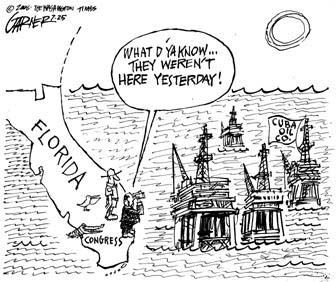
Cuba's Oil Windfall


A few years ago oil was discovered off the northwest coast of Cuba. Lots of it. Or maybe not. Depends on who you ask. To hear the Cubans tell it, it could amount to 20 billion barrels. To hear the United States Geological Survey's views it could be as little as 5 billion. Regardless of exactly how much is there, it's undeniable that it exists. These numbers are nothing to sneeze at and could definitely make Cuba a petro player in the Western Hemisphere. My quick math (assisted by a calculator) tells me that that is enough oil to last Cuba, at their current consumption rate, for over 350 years.

Of course, this find in their backyard has the United States licking their proverbial chops. The only problem is that pesky embargo that has been around for over 40 years. This has lead to debate in Congress as to whether or not the embargo should be loosened to exempt Big Oil from the its parameters to assist in drilling.

Many nations have stepped up to say they're willing to help. Spain has already entered into a production-sharing agreement with Cuba and will start the drilling early next year. Others mentioned in negotiations are Norway, India and Brazil. Meanwhile the United States continues to sit on the sidelines, hands tied by their own embargo. Kirby Jones, head of the US-Cuba Trade Association says this about the US position- "With that much oil, there would be the feeling that there's a real [U.S.] price to be paid for [maintaining] the embargo. It changes Cuba's economic situation drastically and makes the U.S. less relevant." Less relevant? Most likely so. We're like the kids on the playground who huff and puff, protesting a kickball game that didn't go our way- but the game continues. So maybe that wasn't my best analogy, but you get the picture.

The question is still up for debate, though. Many believe this will do nothing more than to spur the US into drilling off its own shores, an idea that is gaining support nationwide. Maybe it's because I didn't live through the Cold War, but the whole embargo seems fairly silly to me. Turning our backs to Cuba doesn't make them go away. It doesn't make them want democratic reform. And that doesn't even take humanitarian issues into consideration.

In the end, it seems like it would be in the best interest of the United States to lift, at least partially, the embargo and allow oil companies to go to Cuba and assist in drilling. This way it is done safely, effectively and we can get a slice of the pie.

Thursday, October 23, 2008

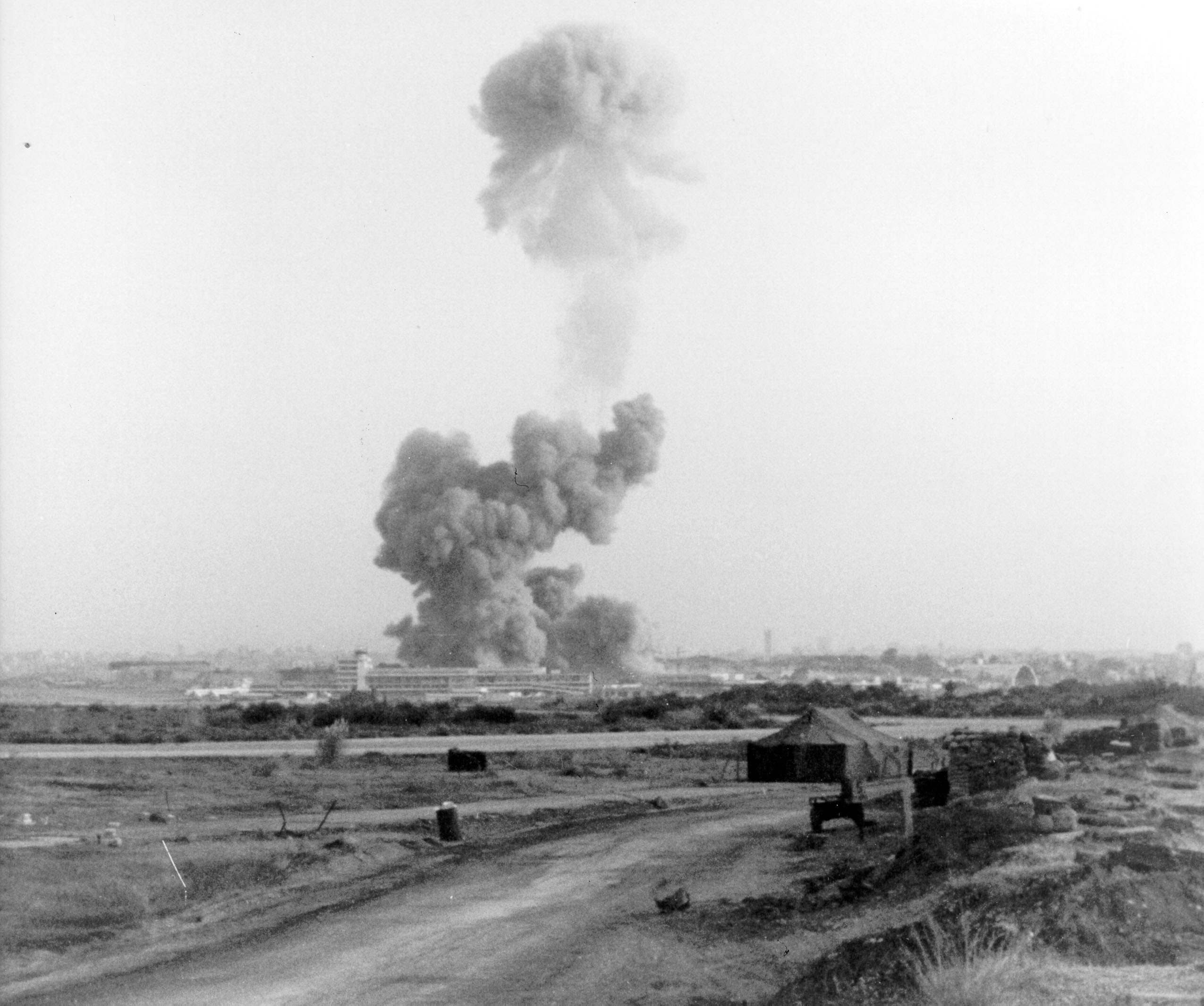
Beirut Barracks Bombing 25 Year Later


On this day 25 years ago, 241 Americans were killed and hundreds more wounded when an explosion the size of 12,000 pounds of TNT – the largest ever non-nuclear blast investigated by explosives experts— was detonated by a suicide bomber at the US Marine barracks in Beirut, Lebanon. This attack was the largest the Marines had experienced since Pearl Harbor. Ultimately, the Reagan administration decided to pull US troops out of Lebanon. This attack and the subsequent withdrawal of US forces has become an important part of the discussion around US actions in the War on Terror. Furthermore, the implications and consequences of this attack are still being played out today.

Although the US pulled the Marines out of Lebanon a few months after the attack, it has not forgotten the incident. The group Islamic Jihad claimed responsibility- a group that many believe is a nom de guerre of Hizbullah. In February of this year Imad Mughniya, believed to be a top Hizbullah leader who was key in planning the 1983 attack, was killed in a bomb blast in Damascus. It is widely suggested that Israel may have perpetrated the bombing, and the State Department expressed its satisfaction with Mughniya’s fate. Additionally, in 2003 a US civil case was brought against the state of Iran as a responsible party to the Beirut bombing. The families of the marines killed in the blast won the suit. Although Iran has not, and may never, pay the amount awarded to the victim’s families, there have been recent efforts by the plaintiffs to seize Iranian assets in the US. Finally, the National Museum of the Marine Corps recently unveiled a display commemorating the 1983 bombings.

In addition to the focus on finding ways to punish those responsible for the attack, there has been much discussion of the barracks bombing as a cautionary tale against retreating in the face of extremism. The US troops stationed in Lebanon in 1982 were supposed to be there as peacekeepers. However, at the time, as well as today, critics pointed out that the Marines were never given a clear mission and were vulnerable to attacks. Although after the bombing President Reagan vowed that the US would stay in Lebanon, by the February 1984 the military was moved offshore and eventually returned to the States. The criticisms have increased in intensity since 9-11 and the War on Terror. Critics, some we have read for this class, assert that US withdrawal gave groups like Al Qaida the perception that America would not risk lives in fighting extremist groups in far away places like the Middle East. Some analysts have asserted that this incident was “a turning point in asymmetrical warfare, especially in the Middle East.” Critics believe this not only strengthened groups like Hizbullah, but it also showed that these types of acts could make superpowers like the US change their policies. Consequently, many supporters of the War on Terror use the Beirut barracks bombing as an example of why the US must not retreat from the fight against extremists.

Yet, I have to wonder what would have happened if the US had committed itself to stay in Beirut after the attack. Lebanese politics are just as, if not more, complicated as Iraqi and Afghani politics- blending religion, clan, and even nationality. The Lebanese conflict is also intricately tied to the Israeli-Palestinian conflict. I have to wonder if it would have been in the best interest of the US at the time to stay and fight. Perhaps the military could have shown enough resolve that extremist groups would not have attempted to target the US in the future. Perhaps the US could have even ended the conflict in Lebanon and secured an open and favorable government that would be an ally to the US and even Israel, instead of being mired in a civil war that was fueled by regional rivalries. On the other hand, perhaps the US would have ended up bogged down in the complicated and deadly politics that characterized the Lebanese Civil War.

Although the US did not stay in Lebanon after the attack, the barracks bombing has continued to shape American policy in the War on Terror and in the region. It has come to be a cautionary tale, but lesson that the US should learn from the incident can still be debated.

Maybe he's not a complete dick...

Apparently David Axe does believe in some amount of humanitarian assistance and even military intervention.

In his most recent blog post at War is Boring, he writes about the cholera epidemic hitting Africa. He also talks about positive developments in combating piracy, and applauds efforts to try to fight both problems. In particular, he seems to worry about piracy in that it affects food aid from getting to the starving people of Somalia.

It doesn't make up for everything, but maybe there's a glimmer of a decent person in there after all.

Wednesday, October 22, 2008

Tuesday, October 21, 2008

Loathing cowboy diplomacy. Or why nobody likes a posturing warmonger

The Eurovision Song Contest makes for an interesting case study in international relations. A Europe-wide, public-voted popularity contest masquerading as a talent show, party-line, national allegiance voting blocs are as passionate as they are predictable. Predictably, the French vote against the Germans. The British vote against the French. Everyone votes against the British.

One can only imagine the carnage if a lucky American starlet were invited to participate. To understand the likely European reaction, we must first appreciate these inalienable truths: 1. Americans are ignorant cowboys. And 2. Boosh is Evil. Everybody knows what the result would be. Right? Ahhh… Not so fast.

“Don’t forget Poland!”, as somebody else once said. That delegation would surely be in the bag. But let’s forget about the pop-music predilections of the Polish teenybopper for one moment (as fascinating a topic as this undoubtedly is). If the rest of the world had the chance to vote on the small matter of the next US President – Eurovision-style or not -- who would get the nod? Who does the world hate least? In the red corner, Senator John Sidney McCain III of Arizona. In the blue corner, Senator Barack Hussein Obama II of Illinois. Who will still be standing when the blonde lady sings? (Please, Britney, don’t sing again.) Let the battle of mixed metaphors commence.

Restoring America’s image in the world: that, according to the meme du jour, is the major task facing the next president of the United States. So, let’s take a brief world tour, to see which of our two fine, natural-born Americans make the outside world’s plebs turn all weak at the knees. First stop is that bastion of liberal democracy, and Governor Palin’s next door neighbor, Russia. But, here – shock horror! – there is no case of Palinmania. Put bluntly, the Baracuda squarely fails to kick electoral ass. Does all her good PTA work count for nothing anymore? Tough crowd. Russia does have a fever, but the only cure is more Obama. In fact, the cold Siberian winter is ameliorated by the positively glowing affection with which the Russian populace regards Barackski. A majority backs the Illinois Senator. By all accounts, the Gallup poll was as free and fair as any Russian general election in recent times. So, nothing to see here! Move along…

So far, so bad for the GOP hopefuls. Presidential candidates are typically doomed to failure when they fail to carry their home states. Luckily for Barack Hussein Obama III, he gets the nod from fully 89% of Kenyans according to a Gallup poll – Kenya being the home of Mr Obama, the elder of course. But according to statisticians, even the formidable 89% figure is most likely an underestimate. With the reverse Bradley Effect taken into account, the real figure could stand at at around 113%.

Senator McCain has always been somewhat softer on the issue of illegal immigration than many of his Republican colleagues (Governor Palin included). Captain Amnesty, as the rightwing blogs took to calling him, has explicitly courted the (legal) Hispanic vote here at home. But what about the main homeland of these “undocumented Americans”? What do Mexicans think of their homeboy Juan Maquiladora? Not a lot, since you ask. Only nine percent back their crusading neighbor. To be fair to Juan, 65% answered “neither” when asked to select between the candidates. Even so, the political distance between Nogales, Arizona and Nogales, Mexico is rather greater than the distance from one side of the virtual border fence to the other.

Take home point from the Mexico experience? Pandering doesn’t work. Or does it? Not so fast – Mr. Barry O’Bama of County Cork, Ireland begs to differ. Of the 20,000 Irish voters sampled, about 100 were sufficiently coherent to respond to Gallup’s questioning. And of this hundred, 67% were heard to slur that Barry was their favored candidate. Pacifist as they undoubtedly are -- who ever saw an Irishman fight? -- the Irish are, naturally, unimpressed by McCain’s tough, neocon foreign policy. Round three to Obama then. (What did happen to that boxing metaphor?).

So, a gung-ho, boot wearing, hat-sporting, twang-talking, gun-toting, truck-driving Good Ole Boy don’t go down too well outside of America, y’all. Have you ever tried to buy a Toby Keith CD in Paris? (That’s in France, Dubya.) Exactly. But, anyways... apparently, threatening to bomb the crap out of people counter to all international standards of diplomacy and with no regard for civilian life isn’t the way to go. Which allows us to segue neatly to the last stop on our world tour: our friend and ally in the War on Terror, (or WoT as the cool kids call it), Pakistan. Awash with advertizing revenue from its booming sales (ahem), The Washington Times dispatched its crew – Jason Motlagh, actually (Motlagh. Crew. Geddit?) – to Lahore to find out who the Pakistanis prefer. One candidate is “too aggressive”, said a student. His foreign policy statements are “irresponsible” said another. The candidate is an “enemy of Muslims” remarked a third, and “more dangerous” than Bush. Of which ignorant, warmongering cowboy do they speak? Senator McSame? Chimpy McBushitler? Umm, no. Why, it's the Obamessiah! The Pakistanis apparently regard an Obama Presidency as less benign than does much of the rest of the international community. Anybody would think that they had reason to fear some kind of baseless, pre-emptive, illegal violation of its territory from a liberal Senator trying to assert his macho foreign policy credentials. How could they think such a thing? And how would Britney Spears do at Eurovision? Ding-ding.

Oh Fly Me to the Moon....


India is preparing to launch its first unmanned space ship to orbit the moon early on Wednesday (tomorrow) Part of its effort to assert its power in space and claim some of the business opportunities out there. The launch of Chandrayaan-1 comes about a year after the first china moon mission. The Indian mission is scheduled to last two years, create a 3 dimensional atlas of the moon, and scour its surface for natural resources, including uranium, as well as ice deposits.

When reading this article, the word uranium instantly sent up red flags from a security standpoint. If this natural resource is found on the moon, how is it to be regulated? Obviously from a U.S. standpoint, the enrichment of uranium for nuclear purposes is of great concern. How then can uranium that is found on the moon be controlled? Is it simply a scenario of finders keepers?
The moon mission, in addition to demonstrating technological capacity, can also potentially yield commercial gains for India’s space program. India’s ability to put satellites into orbit has already resulted in lucrative deals, including from Israel, which has sent up a satellite via an Indian launcher. This of course creates a second implication for United States security. The united states does imagery intelligence better than anyone. One of the things that gives us our edge in intelligence and information collecting on potential enemies is that we are far and away the best at satellite technology. However with the recent rise in science capabilities of both India and China, could the United States be at risk of losing its edge? What would happen to American security if there were a Chinese and Indian satellite in space for every U.S. IMINT satelite. I don’t know about you, but I’m going to make sure my window blinds are closed tonight…

The New York Times Bites My Style

*cough*


Reading my blog posts is like getting the newspaper several weeks in advance.  And they didn't even cite me--stinking elitist liberal media.

Saturday, October 18, 2008

Abortion: The Great National Security Threat

In the last presidential debate, the issue of abortion was brought to the forefront of the campaign for a few minutes. With the differing views of abortion from the two candidates, we need to ask ourselves what are the consequences of their ideas on the issue? Is abortion a threat to our national security?

Since the Supreme Court upheld Roe v. Wade in 1973, 45 million pregnancies have been terminated between then and 2005. That is 45 million more people that could be contributing to our society, contributing to more taxes to help balance our budget, contributing to spreading the greatness of our country to other nations.

The infrastructure of our government is degrading every year. The baby boomer generation is beginning to retire in the next few years, which will increase the strain on the government’s ability to perform basic functions that it has promised to these people. Medicare and Social Security are going broke unless something drastic is done within the next 10-20 years. 45 million more people in the workforce would not eliminate the problem that Medicare and Social Security are facing, but it would certainly have reduced the problem and delayed it so that we would have more time to come up with a solution.

This problem of abortion in our society represents an incredible degree of self-interest among Americans. Regardless of a person’s personal views on abortion, why not think about what is best for the common good of our society instead of thinking about what is best for oneself? People with an unwanted pregnancy see it as an inconvenience that will prevent them from doing something that they want to do, such as go to school or get a good job. Why not see a baby as something that can contribute to the good our country? These individuals could have created a cure for cancer. The military is currently resorting to accepting people with less than desirable backgrounds to fill its need to add 92,000 soldiers to its forces. 45 million aborted babies could have made our military stronger so that they would not have to recruit people with criminal backgrounds. 45 million aborted babies also means less consumers and producers, which equates to less taxes for our government. How can our government not recognize what it is doing to itself by permitting people to abort babies that could contribute to our society in positive ways?

The United States is going down the path of the European societies whose birth rates are not replacing their population. They are experiencing the death of their society and we will also if something drastic is not done in the near future. Russia currently aborts about 64% of all babies conceived there. When they make the threats that they have been making recently about increasing their military spending and threatening the United States, it is nothing more than saber rattling because of their declining population. If they become involved in a major war and experience the loss of life on the scale experienced in World War II, they would not be able to recover and provide the necessary services for their people. We are heading down a similar path. The birth rate among women in the United States is 2.03 births per woman, slightly below the replacement rate of 2.1 children per woman. Our country continues to grow because of population momentum and mainly because of immigration. If immigration were to level off or begin to decline then the United States would experience a declining population, which would place even more strain on the government infrastructure.

The essence of Barak Obama’s views on abortion is that he wants to make abortion even more accessible than it currently is. He supports the Freedom of Choice of Act (FOCA) that would not require minors to notify their parents before an abortion, make abortions legal for all 9 months of a pregnancy, and force health-care individuals who have a moral objection to abortion to participate in the act of abortion or possibly run the risk of losing their job. He calls an unwanted pregnancy a “punishment” that a woman should not have to endure. People with moral objections to abortions probably will not vote for Obama anyway. However, people who don’t have moral objections but are concerned about our nation’s future should also consider how Obama’s view of abortion would affect our national security.

Wednesday, October 15, 2008

Insurgency theory

The Small Wars Journal has out a new article describing a new theory of how insurgencies/guerrillas/whatever you want to call them operate. It's based on trying to synthesize some of the ideas of Mao Zedong and Clausewitz. .

The general idea is that rather than view warfare according to the three "levels" of Mao (propaganda, guerrilla fighting, and conventional warfare), the authors instead view three "poles" of fighting that guerrillas can operate within, moving closer or further from them as tactics dictate. These three poles are terrorism, guerrilla fighting, and conventional warfare. They then use the fighting in Iraq to try to support their idea of these three poles.

From the perspective of Mao, the terror pole makes absolutely no sense, however. All classical guerrilla manuals make it clear that the support of at least a portion of the population is absolutely essential for any successful insurgency. "The relationship between a guerrilla and the people is that of a fish and the water." There is, however, no explanation of this in the article.

There is also no explanation of what causes people to switch from one location on this triangular explanation to another place. The authors just talk about how AQI moved from one to another as a tactical shift, but without much detail.

Moreover, the invocation of Clausewitz in the title is extremely misleading. He is not even mentioned until the very end of the article, in the most passing of ways.

Overall, while there are some interesting ideas in this analysis, it doesn't yet rise to the level of a new theory of utmost utility.

Tuesday, October 14, 2008

I can see Gazprom from my house....


In the Vice Presidential debates of a few weeks ago, along with comments in various interviews, Sarah Palin has been most adamant about her foreign policy experience due to sharing a maritime border with Russia. This morning the New York Times posted an article saying that Russia's state energy company, Gazprom, is now pursuing exploration opportunities in Alaska.

This has some potential economic statecraft and national security implications for the United States. Russia currently supplies oil for much of Western Europe, and according to the article has been looking for ways to get into exploration in the US for several years. The idea is that Gazprom has experience in exploring for oil and natural gas that would help Alaska to develop its natural gas exploration and improve extraction techniques. With current talk of expanding offshore drilling in the US as well as the continuous need for more energy supplies, this could benefit the domestic economy, and increase the amount of natural gas Alaska produces for national consumption.

Is it possible that this could have negative implications along the lines of the Dubai Ports deal? My guess is that since this is Russia and not a Middle Eastern (and predominantly Muslim) nation, it will not garner the same negative feedback from Congress and the American populace at large as the Dubai Ports deal did. However, we do not claim to be on the best terms with Russia now, and many American minds still see American primacy stemming from the Cold War when we were bitter enemies with the Soviets. The American population as a whole may not take favorably to the idea of Russia poking around in our backyard.

We claim to be a nation in full support of free market ideologies and the benefits of competition for consumers. In the face of recent economic events, though, can we still tout those ideals? Would it be too much of a stretch for the federal government to put a stop to this venture as well, citing issues of national security and the safety of a strategic resource from Russian hands?

It will be interesting to see how this plays out in the next few weeks and months, especially with the presidential election coming up. Perhaps this is a bid by Gazprom (and behind it, Putin) to see how far it can push the new president in order to find out how either McCain or Obama will respond to a new foreign policy issue. Who knows. Perhaps Sarah Palin's extensive experience in dealing with the her maritime neighbor will come in handy after all, and assist a new administration in carefully handling those tricky Russians.

Abu Dhabi Media Zone...Outlet for Soft Power?


Recently in a New York Times article it was announced that media moguls, CNN, Harper Collins, Random House, BBC, The Financial Times, and Reuters would join together to build a 200,000 square meter campus called the Abu Dhabi Media Zone.

The purpose of this campus is to mix western media with middle eastern oil money. The Media Zone will offer training to journalists and filmmakers in the region but it will also be a base for western companies to do business.

Harper Collins plans to expand there to take advantage of the growing market for English language books in the region.

With the credit crunch going on in the United States, Abu Dhabi could be a great place for Hollywood to find the dollars for big budget blockbusters.

Finally, Reuters will use their space on the campus to train aspiring journalists in the region.

With all of this money being pumped into an outlet for western media, it would seem that this would also be an ideal outlet for the United States to regain some of its soft power in the middle east. In many of our readings it has been said that a way for a nation to build soft power is for another to come to appreciate and want to adopt or emulate its culture, customs, and ideals. Abu Dhabi has, over the years, pushed to become a cultural center for the world. It would seem that now is the time to not only capitalize on those oil dollars being pumped into the media zone, but also to capitalize on it as an outlet to rebuild soft power by fostering the spread of western books, film, and journalism.
Forget the Voice of America, bring on the Media Zone…

Monday, October 13, 2008

Haider & Hitler: More in common than a hometown.


After the far-right Austrian parties experienced a taste of victory in the Austrian national elections, they just as quickly lost one of the most important men among them. Joerg Haider, governor of the Austrian province of Carinthia, was killed in a car accident this weekend. The name may not ring a bell for most people but it’s important to note the striking similarities from another rather infamous Austrian…Adolf Hitler.

Both men were born in the province of Upper Austria about 61 years apart. However, their similarities go way beyond their region of birth. Despite an age difference of 61 years and the downfall of Hitler’s politics, Haider had been known for Nazi policies and sympathies. The most alarming similarity was their distrust and dislike of those of other races and immigrants. Hitler obviously took it to a much further extreme, but Haider’s reign was shaping up to accepting and pursuing these policies. For example, Hitler set up concentration camps and work camps for those that were unacceptable to his standards. Haider stirred many with his quote that these were “punishment camps.” He further fueled the fire when his campaign, during the 1999 eletion, used the word over-foreignization, the same word used by Joseph Goebbels in 1933.

Many other occurrences highlight Haider’s resemblance to Hitler and his support of his policies. Haider argued that the Nazi SS was a part of the German army that should be honored. Haider claimed he had a strong sense of loyalty to his parents who were early supporters of the Nazi Party. He had also been known to admire the employment procedures of the Nazis.

Sixty-three years after his death, Hitler had a follower, a follower that was gaining political power. However, this rising political powerhouse can no longer personally fight for such conservative policies. With the shocking death of Haider, will Nazi policies recede once again to the history books? Or will someone else step up and continue the far right views of Joerg Haider? His Alliance for the Future of Austria Party recently took 29% of the vote when combined with the Freedom Party. Now we must wait and see where the Alliance Party will go without their charismatic, yet controversial party leader.

Saturday, October 11, 2008

"The List" loses a name today


Today President Bush reached in his desk drawer and pulled out his whiteout pen. He looked around, took a sniff and proceeded to mark over North Korea's name on the list of states that sponsor terrorism. But the official story went something like this...

North Korea finally gets its wish today as the Bush administration announced they would be removing the rogue nation from its list of state-sponsors of terror. The decision came after North Korea assured they were abandoning their nuclear program (again). Secretary of State Condoleezza Rice said the delisting depends on agreeing to a plan to verify the North is following through with plans to dismantle. This will include allowing inspectors (paging Hans Blix!) into the country to monitor activities.

Critics, on the other hand, decry the delisting as a "reward for bad behavior" and that North Korea has no intentions on following through with promises. "Given the regime's decision to restart its plutonium reactor at Yongbyon and actions barring access to the site by inspectors from the International Atomic Energy Agency, it is clear that North Korea has no intention of meeting its commitment to end its nuclear program," said Rep. Ileana Ros-Lehtinen. Nations still on the list include Iran, Cuba, Syria and Sudan.

So around we go again. The dance continues. What does this mean for US-North Korea relations? Probably not much in my opinion. Seems like it is just political posturing and diplomatic negotiations will continue behind the scenes. But, at least a step has been made. The ramifications of these action won't be known for a while, but at least on the surface it is a step in the right direction.