Sunday, October 25, 2015

Migration and security, the European trade off


The migration in Europe has been for some time one of the major security policy concerns for the Union. The elite opinion has tried in the past to shape an appropriate response, by trying to incentivize assimilation. This however has had more or less success as described by Paul Collier’s book Exodus. The author explains here that the constant perpetual flow of immigration does not allow European countries to properly absorb all the newcomers thus creating Diasporas, which are not part of the local society. And according to him, they then keep their beliefs and you start to see friction between migrants and the local population, which may lead to greater instability in the country.  

This difficult situation has gotten worse recently with the conflict in Syria not seeing any improvement. More than 25% of the Syrian population has left the country to try to immigrate to Europe in hope for a better life. With this enormous inflow Europe’s elite opinion has had to change its policy to a much more responsive one. The problem with being reactive is that one cannot afford to be so selective about its choices and has to act more quickly. Some European countries are then thinking about adopting measures that will stop the stream of refugees at the source.

The latest idea proposed by the German government is to apply a value trade off in its relations with Turkey. This country has for a long time wanted to enter the European Union but because of its record with Human Rights, especially with regards on how they treat Kurds, being unsatisfactory Turkey has been denied in its request. It also happens that this country is harboring millions of refugees, most of them from Syria, trying to get to Europe. Germany is then suggesting reopening negotiations with Turkey if the latter agrees to hold more refugees within its borders.


Should such a trade off really be implemented, Germany and the other European countries might see a hinder in their reputation as Human Rights defenders. Especially since one of Turkey’s request is to be seen as a “safe country of origin” during the negotiation process, which would make any Turkish Kurd seeking political asylum in the EU ineligible to do so.  We can conclude by asking ourselves if security is worth turning a blind eye on Turkish loose Human Rights application?

Sources: 
- The New York Times http://www.nytimes.com/2015/10/19/world/merkel-links-turkeys-eu-hopes-to-stemming-flow-of-refugees.html?ref=topics&_r=0 

Tuesday, October 20, 2015

Threat Assessment- According to the Public

           Accordingto a recent poll, an alarming number of Americans believe that Russia poses a long-term military threat to the United States.  More specifically, this poll revealed that 60 percent of Americans think Russia and their military is a long-term threat, while 14 percent see Russia as an immediate security threat to the United States.  This is a drastic change from just ten years ago when more than half of those living in the U.S. claimed that Russia posed no significant threat at all to the United States and its citizens. 
            Surprisingly However, when Americans were asked about the conflict in Syria, more than half said that the situation was not a threat to the United States, but maybe will be in the future.  Additionally, the survey said more (23 percent), thought the situation poses a more immediate threat, and a bit less (16 percent) claims that Syria poses no threat at all.
            So why are more American's concerned with Russia rather than Syria?  Some say that Russia's tensions with the United States have worried American citizens because of the Russian airstrikes in Syria that were partly seen as Vladimir Putin's attempt to support Bashar-al-Assad instead of weakening ISIS.
            Keeping this in mind, the fear of ISIS and the uncertainty as to which side Russia is on has sparked a fear of Russia that has been lingering since the days of the Cold War.  It can also be speculated that the extra worry by Americans regarding Russia is because of the Cold War mind-set that forever altered the way the United States has dealt with foreign policy and national security.  Although a bit far-fetched, it would be interesting to do another poll with a set of questions asking about the Cold War and to the extent to which the person's knowledge about that time period may have affected their answers from the first poll.  Regardless, the American perspective over the U.S. situations with Syria and Russia are important because policy-makers tend to cater towards public desire even if their knowledge on the situation may be mediocre at best.


Friday, October 16, 2015

Nuclear Deal 2.0 ?


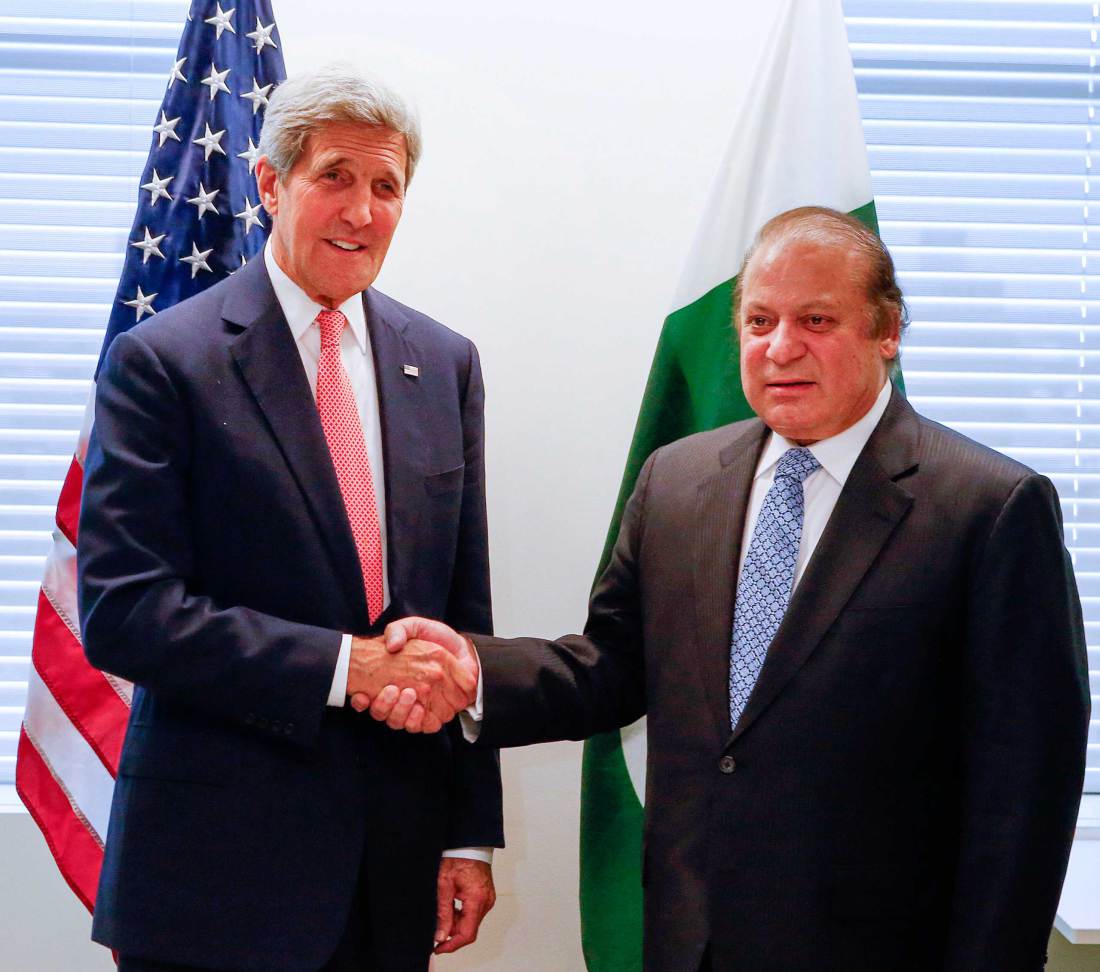
In attempt to pursue its strategy of denuclearization of the Middle East and Asia after having successfully carried out a deal with Iran. A deal that has just been ratified by Tehran on October 14 2015. The United States is considering the possibility of trying to put a deal in place with Pakistan.
President Sharif is set to visit the US next week, which is when the American government should start pitching to Pakistan a possible deal, that will focus on convincing them to stop producing short range nuclear missiles, much easier to move around and thus to fall in the wrong hands.

However this deal really has to be seen has a strategic objective, something that the US will have to work for in the long run, probably even after the end of the Obama’s administration. 
Pakistan right now resents the US for multiple reasons, firstly they still feel absolutely disrespected after the raid on Bin Laden was carried out without their approval and thus not respecting their sovereignty. Islamabad also did not take very well the fact that the US is assisting India’s civil nuclear program since 2005 even though it is not supposed to, as New Delhi is not a signatory of the Non Nuclear Weapons Proliferation Treaty.
Perhaps the biggest obstacle for this new tentative in the US grand strategy of reduction of nuclear weapons is not so much how Pakistan feels about America, as it is its deep fear and hatred of it nuclear neighbor India. Pakistanis see nuclear weapons as the only viable deterrence that they have on India, which is much stronger than they are.
The strategy here in order to be successful may also have to include India in the deal, in order to convince all parties that they can trust each other; and the US might have to concede in helping Pakistan too on its civilian nuclear program to reassure them that the goal is not just to help India but the entire region. Nevertheless this will no doubt be a hard mission for this administration and probably the next as Pakistan feels every day more left out by the US and India who are increasing their military and commercial ties.

Sources:


Tuesday, October 13, 2015

Is American gun violence a greater security threat than transnational terrorism?

Following the Umpqua Community College shooting, President Obama asked media organizations to compare the number of Americans killed through terrorist attacks in the last decade with the number of Americans who have died in gun violence. That image, displayed below reveals some remarkable findings.
If you take out accidental deaths and suicide the numbers look more like this:
Source: State Department/Micah Zenko, Justice Department
What can we say about these graphs? First, it would appear the Global War on Terrorism is working. The trillions of dollars spent in the past decade seem to be keeping American fatalities near zero. Yet, there is the glaring number of around 11,000-12,000 people a year dying to gun violence. In terms of American deaths, it is far more likely you will die by gun violence than a terrorist attack. But that does not mean gun violence poses a greater security threat. Terrorism is more than violent acts. It's ideology, corrupt perspectives, and a manipulation and distortion of some deeply held religious views. It's all of this and more. Terrorism has the ability to destroy nations, cripple moderate or democratic movements, and marginalize non-violent communities. Ultimately, the threat of terrorism goes beyond the number of deaths. 

That being said, far too many people die from gun violence in America. As we prepare for the Democratic debate tonight, a large focus will be over gun control. It will be interesting to see in the coming months and in next years election, what progress can be made to lower these numbers. 

Monday, October 12, 2015

A More Nuanced Foreign Policy: Realism and the Necessity of Playing Rough

            Bruce Thorton, a Fellow of various institutions and a professor at California State University, recently wrote an article criticizing the Obama administration’s foreign policy towards Russia and the conflict in Syria.  In short, the US has focused too heavily on international liberal desires for democratization and failed to understand Russia’s realist foreign policy.  In fairness to President Obama, Thorton argues that similar quixotic delusions of “shared commitment[s] to peace, prosperity, democracy, and human rights” preceded him from the George W. Bush administration.  The National Security Strategies of 2006 and 2015 similarly demonstrate that expanding democracy remains central to US foreign policy.  This article is not without a theoretical foundation of its own, clearly analyzing the world from a firm foothold in the realist perspective.  The underlying argument is nevertheless compelling.  The US has fundamentally misread the orientation of Russian Foreign Policy.  From the expansion of Russian influence into Crimea and Ukraine to its bombing of anti-Assad rebels, Russia perceives the world through a primarily realist lens.  Material power and influence are the nation’s core foreign policy focus, one that is unencumbered by concerns of democratization.  The US, meanwhile, has focused too heavily on the panacea of costly democratization and the spread of international liberalism.  It has thus found itself flatfooted in responding to Russian maneuvers.

While the United States has dissipated its energies tilting at the windmills of creating spontaneous, stable western democracies in the infertile grounds of Iraq and Afghanistan, Russia is playing realpolitik.  With the stalled drive against ISIS and the gradual erosion of Assad’s position, Russia seized the opportunity to assist its ally while appearing to join the effort to eradicate ISIS.  A glance at a map of Russian airstrikes, however, quickly shows Russia’s true targets.  The result has been significant advances by Assad forces and securing Russia’s sole Mediterranean naval base.  Russia’s conquest of Crimea presents a similar case of exploiting weakness in the region to expand control, as well as acquire Crimea’s Black Sea naval base.  Once again, these moves surprised a western world that should have anticipated these realist behaviors.  This is not to claim that the US should relinquish its values.  Indeed, our support for democracy, though occasionally overzealous, is an important part of our national character.  However, the US must recognize that many international actors operate from a realist perspective and it should adjust its foreign policy towards them accordingly.  Until it does so, the US will continually struggle anticipate the otherwise expectable behavior of realpolitik nation’s like Russia playing for their own interests.

Friday, October 09, 2015

New Front for Russia


The situation in Kunduz, Afghanistan, might be even more alarming then what the United States and its allies originally thought it would be. After the city fell into the hands of the Taliban and the accidental bombardment from the US Air Force of a hospital there; the region is more than ever under scrutiny. The Taliban are now gathering their forces in the northern region of Afghanistan and may consider going into Tajikistan, where they also have sympathizers. They are feeling embolden by their victory in Kunduz and the newfound pressure put on the US and Afghan army to intervene in the region.
This situation has caught the attention of another permanent member of the United Nation Security Council. Russia and President Vladimir Putin are feeling more and more concerned about the situation in Afghanistan, and a possible spillover to other countries of central Asia. Especially if they are members of the Collective Security Treaty Organization (CSTO); this agreement between Russia, Armenia, Kazakhstan, Kyrgyzstan, Tajikistan, and Uzbekistan ensures that every member will assist the others in case their territory is invaded or their political stability is at risk. With Kunduz being just 70 kilometers away from the Tajik border, Moscow does not want to take any chances and has deployed, as of October 7, 2015, seven more combat helicopters to its base in Tajikistan that also happens to be the most important one that the Kremlin has outside of Russia.
Russian officials seem to be ready to open a second front even though they are currently involved in Syria in the fight against radical Islam. This news, even though it has been partly overshadowed by what Russia is currently doing in Syria, seems to indicate that President Putin wants to play a bigger and more decisive role in the fight against religious extremism. An extremism that Russia actually believes to be the direct result of poorly handled interventions the Middle East and Central Asian regions by the United States and NATO.
The new will to take military control of the situation, demonstrates one more time that Russia is really determined to regain its status of international military power and that it may not shy away from intervening further and further away from its borders if their interests are at risk.

Source:

Wednesday, October 07, 2015

Game of Speakers

           On Thursday, October 8th, House Republicans will vote to replace John Boehner as Speaker of the House.  Following Thursday's secret ballot, there will be a full floor vote later in the month.
            In response to the lack of enthusiasm for front-runner McCarthy, Chaffetz announced his campaign for the position on Sunday, October 4th, reiterating that there would not be enough House support for McCarthy when it came down to the vote later this month. 
            McCarthyinfuriated Republicans in his efforts to improve his stance on foreign policy and national security when he insinuated that the House oversight investigations over the attacks in Benghazi had politically affected Hillary Clinton, which the Republican Party has continued to claim that the investigations were non-political.
            Although an apology followed McCarthy's presumptuous statements, he still proceeded to make bold statements claiming that his approach to foreign policy and defense is drastically better than anyone else's.  In summary, McCarthy believes that President Obama does not adequately support American allies and that his diplomacy skills are severely lacking.  Further, McCarthy backs a conflict based foreign policy rather than a diplomatic one, being quoted saying that, "strength and resolve bring peace and security."  Additionally, McCarthy goes as far as saying that leaders in areas of conflict such as Russia, Iran, and Syria, only become serious with dealing with the United States when military action is threatened because it "is the only language they understand."
            In essence, McCarthy has, as of late, threatened his support with his outlandish statements and his comments on the House oversight investigations, calling Republicans to encourage Chaffetz to put his name in this game of speakers, further causing internal drama that is hurting the GOP. This detriment to the Party is due to the fact that the race for House Speaker is so high profile, especially since it is occurring amidst an already complicated Presidential election.  Once again illustrating that the GOP is falling into the trap of being their own worst enemy, having a House and a Senate under Republican control and still not being able to formulate a unified agenda to put in front of President Obama regarding foreign policy, most notably a plan for national security as issues with ISIS become more and more dangerously complex.


Tuesday, October 06, 2015

Taking Heed to Past Presidential Warnings


The U.S. presence in the Middle East continues to shrink and policymakers are tasked with the choice of deciding how and to what extent to advance their interests in the region. Career diplomats reported that they fail to remember a time when the U.S. maintained such a low influence in the Middle East. Looking to Eisenhower’s Farewell Speech in 1961, he advises that threats cannot be ignored, like they were in the past. This view directly contrasts with George Washington’s warning to maintain a policy of isolationism. Russia remains at the center of the power struggle in the Middle East, exemplified by their military base and control of the airspace over Syria. President Obama chose not to intervene upon confirmation of chemical weapons, which prompts the question of what would incite intervention in the region.

Heeding Eisenhower’s warning surrounding the influence of the military-industrial complex, U.S. policymakers would be wise to plan for the future and avoid massive military spending. Currently there is a juggling act between being bogged down in another costly foreign intervention and maintaining an influence in the region. Career diplomat, Ryan Crocker, asserted, “it’s the lowest ebb since World War II for U.S. influence and engagement in the region.”Reflecting upon both of the inaugural addresses, Obama is required to decide between the recommendations of staying militarily unengaged or acting as a hegemonic power and combating threats because of their global implications. Between the two addresses, both Presidents emphasize the importance of the economy. Increased trade may be the most peaceful transition to greater influence in the region. In addition to trade, it would seem beneficial for President Obama to align more with Eisenhower’s recommendations by increasing its commitment to appease feelings of abandonment in Israel and other Gulf allies following the signing of the Iranian nuclear deal. Former U.S. ambassador to Iraq and Turkey, James Jeffrey, stressed the importance of maintaining a presence in the region, “Nobody is willing to take any risks if the U.S. is not taking any risks and if people are afraid that we’ll turn around and walk away tomorrow.” One predicament Obama and the next president will face is that of intervening in the Middle East with past actions of Afghanistan and Iraq so fresh on the mind of the American public.

Friday, October 02, 2015

Meanwhile in Paris

Philippe-Armand de Bonneval


Today, October 2nd 2015 marks the second day bombing in Syria by the Russian army. This date also marks the day when European heads of states and Vladimir Putin will meet in Paris to discuss the situation in Ukraine.
The Minsk Accords have to be put in place by the end of the year. However there are still two points in this agreement that promise to be very complicated to agree on, and be resolved by this deadline. They are, returning the control of the eastern border of Ukraine back in the hands of the Ukrainian army, as well as the disarmament of the rebels groups in the regions of Donetsk and Louhansk. Given the increase in power show that Russia is displaying right now in Syria, conceding in these two major points to reach a real appeasement of the situation seems highly unlikely.
Standing still on these particular point of the Minsk Accords is all the more important now for Russia because it would help them affirm once again that they do not change their mind easily and that once they promise something they will do it. Changing, as Thomas Schelling says when presenting the notion of coerciveness between states; can make them look weak to their allies; mainly Assad and the Syrian regime that put their trust in the Russian air strikes. Perhaps even worse it may show weakness to their opponents not only in Ukraine but also in Syria too.
To summarize, the deadlock situation in Ukraine may continue for the immediate future, especially now that the international community attention will no longer be focused on what Russia is doing in Ukraine, but more on what Vladimir Putin and his government are doing in Syria. Nevertheless after the meeting in Paris today, the world will have a better understanding on how much Russia is actually prepared to cooperate on the Ukrainian question.

Sources: