Tuesday, October 22, 2013

Oh Good...More Alarmism!

            In an age when cool heads must prevail due the destructive capabilities we've developed, what we really need is...more alarmism?


            While an unhealthy organism may either act in ways it (accurately or inaccurately) understands to be in its best interest, or actively seek to self-destruct, any healthy organism will act in its own best interest. It follows, then, that a given healthy nation should take stock of itself, then chart a course to procure as prosperous a future for itself as possible. With this in mind, we may reasonably imagine that, like the US (well, at least arguably), other nations are working for their own best interest. This is where the logic breaks down, because the actions of nations are guided its leaders, and those leaders do not always act in the best interest of the nation itself. This being the case, the next best step is to determine what the leadership of a given nation is likely to see as being in its own best interest - sometimes that will match with what is best for the nation at large, and sometimes leadership is concerned only with a smaller unit within that nation. Once this determination is made, one might begin evaluating some of the ways in which the leadership in question will go about achieving its desired end. We can then consider whether they have the means to achieve their goals, the allies to support them, or even the motivation to undertake certain courses of action. From George Kennan's Long Telegram of 1946, to the Team B Report approved by Papa Bush under the Ford administration in 1976, we see painstaking efforts to evaluate our opponents, determine their objectives, and assess their capabilities with regard to meeting those objectives.


            Kennan stressed containment due to the notion that the Soviets under Stalin, much like North Korea under the various 'Kim' thumbs, needed to construct a hostile external world in order to legitimize their brand of autocratic rule as a protective measure against the evil world beyond their borders. While he later explained that he didn't suspect the Soviets of wishing to launch an attack on the US at the time, Kennan was not explicit on this point when he basically said that if/when Soviet leadership confronted the US with dangerous hostility anywhere in the world, the US should seek to contain the Soviets in order to prevent expansion. This led to a certain amount of alarmism due to the idea of a Soviet threat.
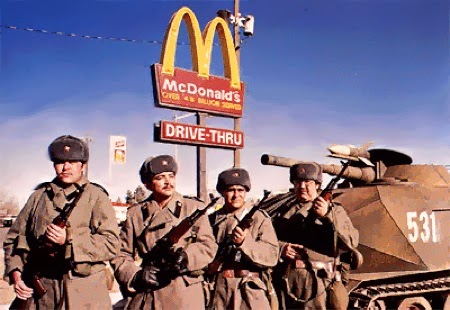


            This alarmism was fueled by the Team B Report, which consisted of assessments by Richard Pipes, Daniel O. Graham, Thomas Wolf, John Vogt, William Van Cleave. These analysts indicated that the Soviets were not chiefly interested in a peaceful coexistence and simply reacting defensively to the threat posed by the US; rather they were more oriented toward offensive strategies and were likely to become increasingly aggressive as their power expanded. According to this report, the Soviets were not buying into the idea of mutually assured destruction; the goal of the Soviet Union was to achieve nuclear first strike capability under the assumption that they could win a nuclear war. More fuel for the alarmist fire.


            In John E. Mueller's Atomic Obsession: Nuclear Alarmism from Hiroshima to Al-Qaeda, Mueller basically explains that we live in a kind of irrational nuclear mania, ever fearing that the entity which has more or less replaced the Soviets as the US' most reviled foe: terrorists, will access these weapons. Mueller explains why he believes terrorists are unlikely to procure nuclear weapons, and that much like during the Cold War, this nuclear phobia drives us to make policies and set budgetary priorities that do not mesh with reality.

            In what appears to be a refusal to learn from our past mistakes, and instead of examining the facts regarding practical nuclear capabilities, we indulge in an almost frantic awe of the power of these magical, mystical scientific innovations. Playing up their capabilities may be beneficial for the purpose of deterrence, for those who are believers in deterrence theory, but for those who prefer to calmly examine reality in an effort to more reasonably plan according to a set of plausibly likely scenarios, it is probably preferable to consider things less zealously. By no means should we undermine the considerable and formidable power of nuclear weapons, but we must awaken from the potent nuclear spell we're under. We need to come fully to our senses and measure nuclear capabilities and our response to them as calm, detached, objective observers.



            While it makes sense to anticipate that other entities will use the tools at their disposal to their advantage, which will sometimes be at odds with our own interests, we must undertake measured consideration of the goals of our opponents, whether they have the means to achieve those goals, whether they have (or need) the right allies to support them, and whether they have the motivation to undertake certain courses of action.

Monday, October 14, 2013

The Great Wall of America: The 8th Wonder of the World?

The Toll of Postponing American Retrenchment from Afghanistan
This past Saturday after days and weeks of high speculation Secretary of State, John Kerry, reached a draft agreement with Afghanistan's President Hamid Karzai on the role of US involvement in Afghanistan after 2014. 
 What is the matter of this bilateral security arrangement?
  1. Afghanistan's political and tribal leaders must not subject American troops to Afghan Law. 
  2. The United States counter-terrorism operations conducted on Afghan soil must respect Afghan Sovereignty.
The main idea behind these arrangements is to discuss the future role of US military engagement in Afghanistan and a transition period.  The Center for Strategic & International Studies released a report on the prospects of US spending transitioning from military expenditure to developmental aid. The findings of the report indicate that the most aid came after the 2009 insurgency and that most of it was not developmental: "The data only tell the amount of money made available of a total category basis. They do not tell how much money actually reached Afghanistan, they do not tie spending to any clear objectives, they did not reflect any effective contracting and auditing system, and there are no measures of effectiveness or success." The graphic below from the report indicates:


That America does not have any measures of effectiveness or success with its military defense spending in Afghanistan is not what Americans want to hear while their country is on the verge of becoming the first major Western country to default since Nazi Germany in 1933.

Is protecting the "Great Wall of America": the deployment of military assets in large bases near enemy borders, worth it? Or will history look back at US hegemony in Afghanistan and label us a wonder and wonder why we trenched our money and American troops so long on foreign soil with reports indicating no success or effectiveness.

In their 2011/2012 Foreign Affairs, Joseph Parent and Paul McDonald indicate that a policy of retrenchment:
1) Would shift commitments & resources from peripheral to core interests
2) Reduce the overall burden of defense
3) Allow America's allies to assume more collective responsibility in improving their own security capabilities and allow everyone to further common goals of Democracy, stability and trade.

The CNN.com graphics below indicate where US Troops come from all over the country and where they sacrificed their lives in Afghanistan- all for no effectiveness and no success when it comes to their country's investments in securing their national interests and the inevitable transition in Afghanistan from US troop withdrawal. After all the American lives lost, the Obama Administration still faces incredible pressure to justify all the agreements and future planned spending. What the United States needs to do is be like the functioning democracies it wants to see in the Middle East and focus on economic stability, growth and progress at home. Hamid Karzai did not want to make any agreement that would not satisfy his country people. Meanwhile, US leadership continues to let American lives take on the toll of casualties in a country that didn't even provide the US jurisdiction over its soldiers (and supposedly still doesn't until this draft agreement is finalized).

The steps the administration is taking to pull out in 2014 echoes a retrenchment policy stance in Afghanistan. Congress demanded that the administration announce its plan this past summer in regards to the number and status of US forces in Afghanistan. And it seems that the administration is continuously working to reducing its military footprint in Afghanistan since the first Obama administration in 2008. America should not fall to the trap that Parent and McDonald stressed two years ago, a pattern of over-consumption, over-extension and over-optimism. Because after all, retrenchment starts with pulling troops out of Afghanistan, creating better measures for assessments of costs and benefits for maintaining the Great Wall of America in Afghanistan, but it ends when America can take the monies saved and spend it here on American soil and bolstering the economy at home. 

The US should not focus all its attention on the wall it has built in Afghanistan but focus on building the Great Wall of America on American soil, one that truly allows us to prosper economically, more effectively handle foreign threats and not have young American men and women pay for it with their lives.

Sunday, October 13, 2013

Oslo Signals, Or the Meaning of the Nobel Peace Prize

It’s always anti-climactic when an organization wins a prize meant for single human being. The purpose of the Nobel Peace Prize should be to reward a human being for their work, as Alfred Nobel’s will puts it, “for the fraternity between nations, for the abolition and reduction of standing armies, and for the holding and promoting of peace congresses.” But the will also specifically says the prize should go to a “person.” Yet this is the second year in a row the Prize has been awarded to an organization.

The key to understanding why the Committee acted as they did is the name of the organization: the Organization for the Prohibition of Chemical Weapons (OPCW). The Nobel Committee awarded the 2013 Peace Prize for “its extensive efforts to eliminate chemical weapons” primarily through its attempts to get countries to become signatories of its Chemical Weapons Convention. An undeniably noble (no pun intended) mission that fits neatly within the conception of the Committee’s purpose of rewarding the peacemakers.

The second question to which the mind runs after answering “why?” is “why now?” Surely the OPCW could have used the money from the Prize much more when they started in 1997. Their current budget is around $95 million, or $25 million more than it was in the late 1990s. The timing is not about throwing a monetary life-saver to a deserving but poor non-profit; instead, it’s about signaling.

The OPCW has recently undertaken a task never before attempted: the oversight and verification of the destruction of a country’s chemical weapons stockpile while that country is in the middle of a civil war. As part of an effort to bring Syria’s al-Assad government into the community of civilized nations, the United States brokered an agreement with Syria’s patron state Russia to rid Syria of its chemical weapons in exchange the United States not launching a missile attack against the al-Assad regime’s forces.

The Committee, however, did not just award the Prize to the OPCW for the purity of its motives and the degree of difficulty of the task it faces. No, the award is a signal to the world at large that the Committee is rewarding the adherence of nations to the principles of multilateralism, international law, and cooperation over the use of force. The OPCW is a symbol of a commitment the Kantian ideal of solving problems between states through institutions rather than the use of force. That’s why the Committee awarded the Prize last year to the European Community, not in specific recognition for a particular act, but to reward a group of nations going through the worst economic crisis of their existence who acted to solve their problems as a group rather than balkanizing. Granted, the Committee stated that the EU’s Prize was for “over six decades contributed to the advancement of peace and reconciliation, democracy and human rights in Europe,” but, again, the EU has been doing that sort of thing for years; its timing is what gives the Prize its significance.

Once one accepts that the Committee is promoting the idea of security and peace through multilateral institutionalism, their more curious – not to say controversial – awards make more sense. President Obama, for example, received the Prize after a scant nine months in office, primarily as a signal to the world of the Committee’s displeasure at the Bush Administration’s unilateral approach to international relations and casual approach to international law, not because of any accomplishment of his own. Other Prize recipients – Henry Kissinger, Yasser Arafat, Nelson Mandela - have both metaphorical and literal blood on their hands, having spent their lives orchestrating or fighting conflicts. 

The important thing for the Nobel Committee, however, was that they worked to make peace at a critical time, restoring order and bringing countries back into the community of nations. In fact, this is part of the signal: Arafat was not being rewarded for his lifetime of violent conduct within the Palestinian Liberation Organization, but for his attempt to bring peace to the Middle East by bringing the PLO to the bargaining table with Israel. So too is the Committee rewarding the OPCW not just for its good works, but for its good works at a critical point in the history of international relations.

Saturday, October 05, 2013

Is Iran Really Changing National Security Strategy?

What is Iran’s national security strategy?  The election of Rouhani seems to offer an unparalleled opportunity for an agreement on Iran’s nuclear weapons program and rapprochement with the U.S.  If looks are to be believed, Iranian national security strategy has shifted away from nuclear weapons attainment.  Yet there are many who see this new diplomacy as a gambit to gain enough time to finish producing a bomb.  Instead of a new national security strategy forgoing nuclear weapons, they see a different tactic to achieve the same goal.  As we discussed in class on Monday, inferring the strategy of another country can be far more difficult than it seems.

Yet it can’t be denied that the shift in Iranian diplomacy has been shocking.  Rouhani has tweeted his Rosh Hashanah felicitations.  Instead of Ahmedinejad's total Holocaust denial, Rouhani moved first from soft-core denial  (“I’m not a historian...”) to actually saying that what the Nazis did to the Jews was bad.  He says his government is ready to hold talks with the United States to seek an agreement on Iran’s nuclear program and after John Kerry met with the Iranian foreign minister, Rouhani sought and accepted a telephone call from President Obama, the two countries highest political exchange in 34 years.


Most important to his credibility in these endeavors, Rouhani seems to have the support of the Supreme Leader.  During the election campaign he was written off as a candidate far too liberal for the conservative establishment to allow winning.  But he did, and since then the Supreme Leader has issued a fatwa against nuclear weapons and is talking about “heroic leniency” in foreign relations. After Rouhani returned to Iran, the Iranian parliament officially expressed support for his diplomatic efforts.

If Rouhani and the Supreme Leader are sincere, the outcome would be a sea change in Iran’s national security strategy – instead of nuclear security they would have the security of international legitimacy.  Economic sanctions would be lifted and Iran would no longer be seen as a pariah state.  Talks begin on October 15 and we can only hope this comes to pass.   

However, there are those who look at Iran’s behavior and see a play for time in order to finish a weapon – instead of a new national security strategy they see a shrewd change in tactics from belligerency to diplomacy in order to achieve the same goal.  The view of these hardliners was represented this week at the UN by Israeli Prime Minister Netanyahu who scorned the credulity of those that would accept Rouhani’s outreach.  He pointed out that Rouhani was head of Iran’s Supreme National Security Council from 1989 to 2003 and went on to say, "Rouhani was also Iran's chief nuclear negotiator between 2003 and 2005. He masterminded the strategy which enabled Iran to advance its nuclear weapons program behind a smoke screen of diplomatic engagement and very soothing rhetoric."

So who is right?  The answer is that neither side knows and no matter which course the U.S. takes it will be acting with imperfect knowledge.  The strategic culture of nations is often quite different from each other.  There may be limitations on the scope or dynamics of national strategic thinking in Iran that the U.S. is not aware of.  We assume other countries have a thought out grand strategy, yet our leaders sometimes find themselves representing undefined positions.   It could be that time will show that Rouhani is sincere…or maybe it won’t.  He could be too far off the ranch right now –if he is reined in by the hardliners whom he and the Supreme Leader work with then perhaps we will never know if this was a moment that could have been exploited to even further gain. 

Goldgeier’s “The Fall of the Wall and American Grand Strategy” discussed the difficulty American policy makers face developing coherent strategies in the post Cold War era because the international situation has become much more complex.  But other nations are faced with this more complex world as well.  My take is that Iran has always wanted prestige, power, and cultural distinction.  It has seen a security strategy of nuclear weapons as a way to attain this.  But after years of sanctions and pariah status it is muddling through to a new strategy where perhaps these goals can be achieved peacefully.  The Supreme Leader probably hasn’t drawn a policy memo outlining this strategy.  But he and Rouhani are trying it out.  If it sees dividends then perhaps he and the rest of the establishment will muddle through all the way to Iran’s return to the international community.

The Impact of the Government Shutdown on National Security


With the news that Secretary of Defense Hagel will recall most of the 400,000 civilian Department of Defense employees furloughed last week during the government shutdown, it perhaps appears that the impact of the shutdown on US national security will be even slighter than it first appeared.

Indeed, that is the intent of the Hagel recall. Of course, no military personnel gets sent home in the event of a shutdown; the federal government would have to literally run out of money before it would stand down troops or shut down weapons systems and open itself up to threat as never before. While the DoD is not at the bottom of the shutdown pecking order (that honor goes to the Department of Veterans Affairs, who have furloughed only 4% of their 332,025 employees), neither are they at the top – nearly every single one of NASA’s 18,134 employees got sent home (excepting, of course, the ones currently in outer space).

In addition, the Department of Homeland Security is also extremely well-protected from the shutdown-induced furloughs, as nearly 9 out of every 10 of the 231,117 DHS employees stay on the job. So America’s ability to project its power and defend the homeland remains more or less intact, unbuffetted by the winds of discord currently howling through the capital. If we measure national security in terms of planes, guns, tanks, and troops, the government shutdown seems hardly to have made a dent.

Unfortunately, “national security” is a concept, not a concrete measure. America’s national security is tied to its position as the hegemon of the international political system. The collapse of the Soviet Union signaled the end of the Cold War in 1991 and heralded a switch from a bipolar system to unipolar one in which democracy twinned with capitalism were declared the unanimous political and economic philosophical victors over authoritarian systems and planned economies.

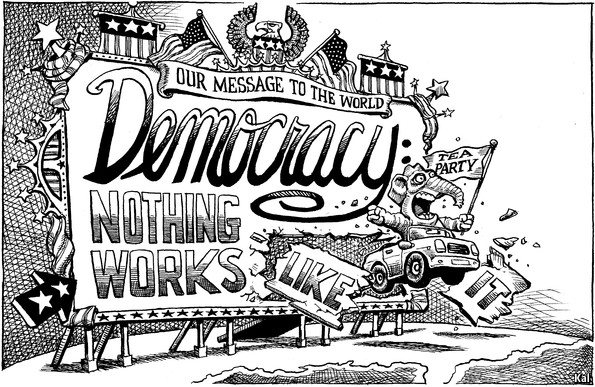
The longer the government shutdown continues, the less secure the American position becomes. The less trustworthy the American political system seems, the less viable democracy as a concept appears. The less certain the rest of the world is about America’s ability to govern itself, the less willing they will be to participate in the economic system of which the American economy is the linchpin. Granted, the global marketplace seems to have anticipated the shutdown, and both American and European markets finished up on Friday while the Asian markets suffered only minor losses. But the longer the shutdown continues, the more uncertain the marketplace will become, especially if the Congress refuses to increase the debt ceiling on October 17th, an event most analysts suggest will trigger a severe global economic downturn.

Such a downturn would only increase the amount of uncertainty about the future of the international system. This uncertainty would certainly breed instability, as more and more people outside the US would question the soundness of democracy as a political system if it can be ground to a halt by a relatively small minority of extremists, a group of people who would think nothing of endangering the global financial system to make a political point. This seeming inability to govern itself or to take the consequences of its actions on a global scale into account, combined with a reluctance to act forcefully against a leader who commits acts of violence against his own people in violation of international law in Syria, could reduce the faith the rest of the world has in America’s ability to remain a hegemon, a nation that can act both to enforce global norms and protect itself.

To put it more simply, the longer the government stays shut down, the weaker America’s position in the world becomes, and greater the risk to American national security.


The new face of assassination?

Photo Credit: Dailybail.com
Assassination has never changed the history of the world.”
- Benjamin Disraeli


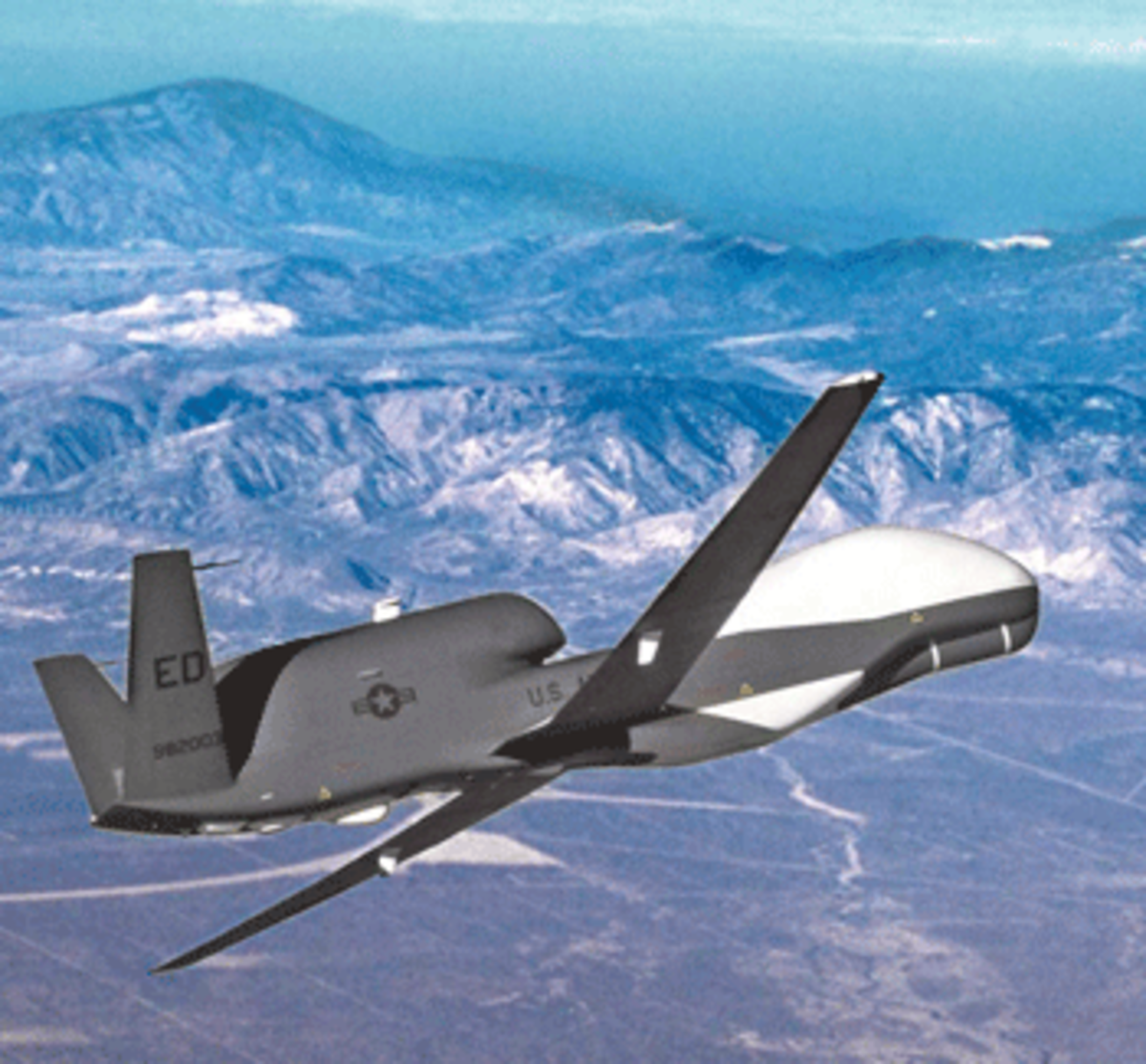
On October second, the body of Mojtaba Ahmadi, commander of Iran's Cyber War Headquarters, was found in the woods outside of Tehran with two bullets in his heart - most likely delivered there by Mossad. He is the seventh Iranian scientist or military figure to be assassinated since 2007. Meanwhile the United States has killed close to 2,500 suspected terrorists and militants in drone strikes, in addition to roughly 800 civilians. My colleague has attempted to rationalize this tactic in the framework of just war theory. However, there is a flaw in this analysis - the drone campaign is not a war. It is a campaign of assassination, much like Israel's campaign against Iranian scientists.

Photo Credit: thecontributor.com 
The use of drones is one of the many tactics employed in the "War on Terror," which is a war in name only. Even if one is to accept the premise that the War on Terror is in fact a war, that would in no way legitimize drone strikes as a valid tactic carte blanche. 

This is not to argue that drone strikes and other "targeted killings" (to use the governments parlance) are not a potentially effective tool against security threats to the United States. Some reports indicate that al-Qaeda and the Taliban have had some difficulty replacing leaders killed by drones and military operations. In combination with other tactics attacking the deep-seated causes of terrorism against the United States, they may still yet have a valuable role to play in American foreign policy.

The United States has an extensive history of using assassination to further its foreign policy goals, from Castro's poisoned cigars to the SEAL raid which killed Osama bin Laden. Drones are simply the latest and most efficient in the United States' killing arsenal. An argument can certainly be made for the continued use of drones, but not in the framework of being "just."


Friday, October 04, 2013

Grand Strategy in Africa


It is often difficult to implement a grand strategy because of the electoral impediments within the U.S. and the often-volatile relationship between our branches of government.  And administrations that hold different ideals and values make it difficult to implement a clear and continuing grand strategy for our national security policy.
The grand strategy for America after 9/11 could be summed up as the war on terror. President Bush waged this war on terror during his time in office, President Obama recently declared the war on terror over and that al-Qaeda was on the verge of defeat.  While the use of drone strikes has greatly diminished the threats and capabilities of al-Qaeda, they still remain.  In the month of August, 19 diplomatic missions across the Middle East and North Africa were closed based on a conversation between al-Qaeda leader Zawahiri and Nasser al-Wuhayshi, the leader of al-Qaeda in the Arabian Peninsula (AQAP) that was intercepted by the NSA.       
Also, there have been several violent and deadly terrorist attacks in Africa the past few weeks.  One being at an upscale Western mail in Kenya to which al-Shabab has claimed responsibility.  Another was a deadly attack on a Northern Nigerian agriculture college that left at least 40 students dead (many of whom were sleeping).  While Boko Haram has not claimed responsibility for this attack it does bear considerable resemblance to their previous attacks.
            Al-Shabab means “the youth” in Arabic and became the radical wing of the Union of Islamic Courts in 2006.  During that time they fought against Ethiopian forces that entered Somalia to back the interim government.  They impose strict sharia law in the territories that they control.  In February of 2012 their leader, Ahmed Abdi Godane, pledged his obedience to al-Qaeda’s Ayman al-Zawahiri.  And they have increasingly used guerilla tactics in their attacks.  They do carry out attacks outside of Somalia, as evidenced by their guerilla-like attack on the Nairobi Westgate mall.  
In English, “Boko Haram” translates into “Western education is sin.”  Boko Haram’s main goal is to establish a Muslim state in northeastern Nigeria.  Their violence has killed more Muslims despite often seeking to kill Christians and attack Christian institutions.  Their primary targets are schools, which make it quite likely that they were responsible for the attack on the agriculture college.       
There has been a growing partnership between al-Qaeda in the Islamic Maghreb (AQIM), Somalia’s al-Shabab group and Nigeria’s Boko Haram.  Each of these three groups has been greatly influenced by Saudi based Wahhbism and seeks to rid Africa of its western influence.   The U.S. has been fighting against al-Qaeda since the attacks on 9/11, but with the spread of al-Qaeda’s influence in Africa, the U.S. could easily become more involved than they already are.
The U.S. has already contributed drones to Kenya to monitor al-Qaeda backed rebels and Nigeria and Ethiopia have purchased small fleets to monitor militants as well.  The U.S. Air Force has encouraged leaders in Africa to utilize surveillance aircraft to dispel insurgent groups.
In light of the threats that al-Qaeda still poses in the Middle East and Africa, the fact that they still target western and U.S. interests, and the connection al-Qaeda has with regional groups Boko Haram and al-Shabab (along with their recent string of attacks) should be cause for the current administration to reevaluate the threat of al-Qaeda and its strategy in the Middle East and Africa.  The threat is definitely still there even though they seem to be focused on the near enemy rather than their far enemy to the West.  It could be easy for these groups to change the focus and direction of their priorities because they do have a large number of militants and they do hold large amounts of territory stretching from West to East Africa. 
If we do not help contain threats outside of the U.S., they often find a way to threaten us here at home.  As we see the escalation of violence in Africa, whether it's led by al-Shabab, Boko Haram, or al-Qaeda and its affiliates, it should continue to demand the attention of our national security and be incorporated in our grand strategy. 

Wednesday, October 02, 2013

If a lady's reputation is her most valuable asset, then Lady Liberty has cause for concern...


Lady Liberty is no longer protected by the shield of her good reputation

The U.S. has long seen itself as the embodiment of righteous, virtuous liberty. We are the good guys who charge in to rescue the oppressed then welcome them into our open arms where they may hope to live out the American Dream of a good life, liberty, and the pursuit of happiness. We are the answer to the rigid and vicious oppression inflicted by brutish nations like Russia and China. We are the voice of reason preventing aggression against defenseless...wait. This battle cry lacks something...thunder? Ferocity? Ah - credibility. Yes, credibility. Lady Liberty has lost - no, adamantly cast aside - her most valuable asset, her good reputation, her credibility.

The U.S. has earned a reputation for being hotheaded and eager for a good fight

It is no secret that the U.S. has earned a reputation for being hotheaded and eager for a good fight. Perhaps formerly perceived as the hard-working, clean-cut, do-gooder boy scout sitting earnestly in the front of the class, the U.S. has sullied its own good reputation and now more closely resembles the ignorant, sarcastic, steroid-inflated bully in the back of the classroom, hungrily anticipating an opportunity to flex our testosterone-infused muscles. Israel, perhaps formerly perceived as the bullied kid who finally got a seat at the lunch table, has joined the U.S. at the back of the classroom. If one is judged based on their associations, then the U.S. and Israel are not reflecting well on one another.


In what has been, not unreasonably, described as an inflammatory speech to the United Nations earlier this week, Israeli Prime Minister Benjamin Netanyahu put forth his best sarcastic effort at sabotaging the tentative diplomatic overtures between the U.S. and Iran regarding the nuclear issue. He attacked Iranian President Hassan Rouhani, seeking to discredit him even as Rouhani pursued appropriate, perhaps even laudable, measures to establish a productive diplomatic dialogue with President Obama. While Netanyahu as well as the international community at large certainly have good reason to receive Rouhani's efforts with skepticism, brutishly going on the attack at such a time just looks like tantrum throwing.


In the same vein of unrefined and "unladylike" behavior, the U.S. seems to have established a default setting to "attack" any time we're confronted with a plausible pretext to flex our military muscles. We have become the "roided up" meatheads of the international community, jumpy in our paranoia that anything that happens anywhere is targeted at us and requires a violent response. 

The U.S. seems to have established a default setting to "attack"

This posture isn't entirely unwarranted, but it seems hasty and reactionary. Furthermore, it makes us predictable - we are too easily prodded. This is the reputation we have established for ourselves, and our close association with Israel, which has established itself as a hothead in its own right, only serves to reinforce that image.

We are too easily predictable

Is the U.S. - or Israel for that matter - unjustified in taking a tightly coiled posture, ready to pounce at the slightest provocation? I propose that we are not unjustified. Rather, we are wearing our emotions on our sleeves and exposing all of our buttons. When we are perceived as so jumpy and peckish that Russian President Vladimir Putin may chime in as a voice of reason, we may easily assess that a re-evaluation of our posture and demeanor toward the international community is in order. What the U.S. perceives as the strength of flexing our awe-inspiring military arm appears more aptly to be a case of the U.S. rising to the bait. 


The U.S. has arrived at a refined black tie event wearing a tracksuit

We are dealing with nations with centuries, if not millennia, of experience in fine-tuning the subtleties of their political tactics. We have arrived at a refined black tie event wearing a tracksuit, flexing each time we're poked. We are exhibiting very unladylike behavior, and our reputation is tanking as a result. I think we're still the good guys, and Israel's not so bad either, but we need to remember that there is an etiquette to international relations, and that if we want to stay on top without having to engage in constant military campaigns, we need to conduct ourselves in a more ladylike manner. Lady Liberty must be...well...a lady.