Apparently, pirates in Somalia have captured an Iranian ship, but now all of those pirates are coming down horribly sick and dying.
The overall story is rather confusing, and I had a hard time with the article, but the basic gist was:
1) The MV Iran Deyanat reached the Gulf of Aden August 20, with an expected arrival in the Suez Canal on August 27th. The trip should only take the ship 4 or 5 days, however. According to the manifest, it was carrying iron ore and "industrial products", bound for the Netherlands.
2) Sometime shortly after entering the Gulf of Aden (definitely before August 23rd), the ship was hijacked by pirates around Puntland in northern Somalia.
3) While negotiations for a $2 million dollar ransom were being worked out, the pirates asked for the local "authorities" (the people who run Puntland) to come investigate the ship. While no one recognizes Puntland, it is a self-governing autonomous area, where law and order are pretty well established on land. This is typical, as the pirates seek some legitimacy by claiming to stop illegal fishing and weapons sales. The pirates claimed to find weapons bound for Eritrea there.
4) Here comes the weird part: On September 4th, when the authorities got there, they found that many of the pirates had weird burns, loss of hair, and other complications. Many of them had already died.
5) On the 6th, an agreement was reached for the $2 million, but never followed through. On the 10th, the US levied sanctions against the Iranian shipping company, and negotiations were broken off. On the 12th, the US offered $7 million for the ship.
6) Currently, there are French and US Naval vessels off the coast, to inspect the ship as soon as it leaves Somali waters. They can do so under the suspicion that it is carrying weapons to Eritrea. The Russians are sending ships down there now as well. It's been suggested that Iranian subs (Iran has subs??) might try to take the ship down before anyone can get to it.
My overall question: What the hell could be causing the medical complications? The article says that chemical weapons are unlikely (but rumored), but what else could it be? Some kind of radiation? There's nothing nuclear or radioactive mentioned in the manifest either. Random outburst of an epidemic of some kind that causes burns??
And where would it have picked up such an odd cargo? If it picked up either radioactive material or chemical weapons in China, and is trying to smuggle them into Iran, why would it be going into the Gulf of Aden/Suez, which has a rather large peninsula between it and Iran. (And any means of smuggling from there to Iran would likely go through Iraq, which would not be a good idea.)
The idea that they were smuggling weapons to Eritrea makes more sense, because Eritrea is on the way. But...chemical weapons?
I'm honestly looking for explanations here. (And, on top of that, the question of the $7 million ransom the US offered, $5 million more than the Iranians agreed to.)
Thursday, September 25, 2008


Wednesday, September 24, 2008
Where's the water?
 This is in response to the water post of a few days ago...
Michael Klare talks about the tendency toward resource wars in the future that apply to this very problem. As nations continue to grow and develop, gaining higher levels of income and living standards, they demand more and more water. Klare suggests that most nations prefer to rely on their own supplies of strategic resources whenever possible, but this will become more impossible with global water supplies because there is a finite amount of water in some instances. Many nations around the world rely on fresh water flows through major rivers. This is a problem because a river may flow through several countries before it gets to the nation in question. Klare notes that the Nile flows through nine countries, meaning that one country may run the risk of losing its water if another cuts off the supply.
Water becomes even more scarce when rich(er) country governments divert water to irrigate farmland for their constituents with little regard for displaced and therefore unheard populations. For example, Israel's move to divert water from land farmed by Palestinians to irrigate land farmed by Israeli settlers. The Palestinians who are dependent upon agriculture for their meager livelihoods do not have a voice in the decision-making process and therefore do not have the ability to protest these moves. A recent article from Reuters notes the disparity of lush and thriving Israeli crops located next to dry and brown Palestinian crops.
When populations are divided from vital resources, such as water, they begin to seek ways to gain access to vital resources. The end result is perhaps violence and revolution. The potential problem for the Israelis is that continued Palestinian oppression will build more of a case for the Palestinian population to revolt. Klare's resource wars may come to fruition if it becomes a question of whether to starve or fight for water. The rich countries will not really have a problem gaining access to water reserves; they have enough money to buy up available reserves at almost any price. The issue is for the poor and desperate populations of the world that will not have the money to afford high water prices. These groups will either face starvation or the incitement of violence.
In the coming years as environmental problems worsen around the globe, due to pollution and global warming among others, the United States may find that its national interest will be to protect and maintain vital resources for poverty stricken and resource vulnerable populations. We talked about the prominence of the need to recognize human dignity as part of a strategy for national security, perhaps the US would be best served by a policy that enables oppressed peoples to gain access to vital resources such as water.
For further reading, try this article from the BBC from May of 2007.
It's Just a List, Get Over It

Week after week, we hear either Iran or North Korea complain because they are on the State Sponsor of Terrorism List. In some cases, they tend to complain about its more fashionable, 21st Century name, "The Axis of Evil". Seriously, get over it. Who cares about a list? What does it really mean? Didn't we learn as kids that "sticks and stones may break our bones, but words will never hurt us"? Surely, we can't be so ignorant as to think that North Korea would really dismantle its nuclear program completely just to be removed from this list. Nor should we believe that Iran really gives a hoot about the Axis of Evil (they know they are evil, and the truth hurts). They don't, and it certainly shouldn't be considered a negotiating piece if Iran ever earns a spot at the bargaining table. Sure, it would be easy for me, an American, to say I could give a rat's rear about this list. But actually, I do care about the list. It makes perfect sense. Why shouldn't we label those governments that have the capacity and irrationality to harm or assist in the endangerment of others through development, use, or proliferation of weapons of mass destruction? It seems like our duty. In the end, those nations on the list should hate being on it, as it was designed to hurt them, and in fact, to embarrass them into different politics. Our allies should embrace the list and enforce the sanctions that go along with its repercussions.
As silly as it is that we actually care what Iran and North Korea think about this list, it is even more hysterical to listen to Americans that oppose the list. Many of them blame the Bush administration for the list, or for upholding its importance. Some would say that "it is a laminated paper on the desk in the oval office that can be erased and added to as if it were nothing."
Seriously, this list has existed since 1979. It is maintained not by the President, but by the US State Department. ( http://www.state.gov/s/ct/c14151.htm )
So oft are people ignorant on these things that they often try to blame one administration, and in fact, they target the entirely wrong political party. Syria was the first state added to the "list" in 1979. Therefore, Jimmy Carter (shhh, don't tell anyone, but he was a Democrat, not a Republican or a neoconservative - how crazy?!?) passed his list through four Presidents to its current holder, W. The states on the list include Cuba, Syria, Iran, Sudan, and North Korea.

If you're interested in their rap sheets, link here (http://www.state.gov/s/ct/rls/crt/2005/64337.htm ).
As the list stands, the last nation added was the Sudan. It was added in 1993 (hold on to your seat) by Bill Clinton.
In 2002, a speechwriter in the White House used the term Axis of Evil, and the president officially coined it. I was passed out and unconscious on 9/11/2001, but one of my friends said something horrible, even evil, happened that day. So, really, I have no idea where that name came from, or why we can't call it how we see it.
Let's just get the facts on the table before we start bashing people, and let's get off the list, its just name-calling...who does that hurt? After all, the majority of people reading this are on the Great Satan's rolls.
Tuesday, September 23, 2008
Moving North we have.....more trouble

The Russian invasion of Georgia over the conflict in South Ossetia raised many questions about Russia's stance on break-away regions. They had widely condemned the West for its support of Kosovar independence, yet seemed to support it for South Ossetians. This precedent may be tested again as tensions rise just north of the border with Georgia in the autonomous region of Ingushetia.
The Ingush became part of the Russian empire in 1810 and were part of the Chechen-Ingush Autonomous Socialist Repbublic from 1936-1944 when they were disbanded and deported to Central Asia. Upon return at the dissolution of the Soviet Union, they found that their neighbors, namely N. Ossetians, had taken their land. Lawlessness has prevailed their for 15 years, and their is a rising tide of Islamic extremism (several of the Beslan terrorists were from Ingushetia). Many want to be independent of Russia.
On September 12th, the director of the Ingush Motor Vehicle department was assassinated. The problem is he was the president of Ingushetia's first cousin. At the funeral there were many protestors screaming for blood-revenge and invoking the name of Allah. President Murat Zyazikov is pro-Kremlin and a personal ally of Premier Putin. His stance has angered many of the Ingush people and there has been a budding opposition there in recent times. Accidentally, so the Russian police claim, the owner of opposition website ingushetia.ru was shot four times and dumped out of a vehicle after being detained on August 31st(Oops!). On July 3 Russian police officers and a senior intelligence official were killed by separatists. Or organized crime enemies. One can never be sure.
Moscow has criticised Zyazikov for his weak response to the rising unrest. Opposition groups are calling for his resignation or they will declare their independence,"just like Abkhazia and South Ossetia". There have been adequate provocations on both sides. The 'accidental' killing of a popular opposition leader ignited the base seeking independence. The murder of the president's cousin, though not clear who's responsible, is being used to call for oppression of the opposition. This, in turn, is further convincing the minority of their need for a collective front of resistance. These events are incredibly similar to the summer unrest in South Ossetia - which was celebrated with a war.
So, as drones are continued to be shot down and rhetoric exchanged over Georgia, a fresh crisis is awaiting on the way back to Moscow.
The Cost of a War on Terror

It’s election time again; a time when politicians somehow manage to make fashion statements and political buzzwords turn into gold with a little help of the media. With the upcoming presidential debates, it is guaranteed that the American people will encounter new phrases and promises, along with some old matters of business. For example, the War on Terror will inevitably spark a heated debate between the two candidates. Undoubtedly, one side will argue for success, while another will proclaim that withdrawal of troops is necessary. Perhaps it is not as simple as choosing sides, since both parties will ultimately have to deal with the war regardless of who wields the executive power. Both plans will take time, energy and money. Blame has already been awarded and mistakes have already been made…but the effects of the fight against terrorism will permeate throughout the American society for decades to come. Regardless of who wins or who loses the presidency of the USA, future Americans will have to deal with the aftermath of the War on Terror. How much will this war cost us?
It is not even necessary to discuss home many lives of American soldiers have been lost, not to mention the civilian causualties of Iraq and Afghanistan...we know that the numbers are outrageous. Also, due to the exponential figures, it is unnecessary to mention the cost of the War on Terror in terms of dollars and cents. What often goes without mention, however, is what the War on Terror has cost the United States in terms of opportunities. Focusing so much time and energy on the fight against terrorism has, for years, distracted the United States from progress in other areas, such as Asia, Russia and Latin America. As one reporter in TIME magazine explained, “The longer the U.S bases its foreign policy around the single-minded pursuit of Islamic terrorist, the less influence it is likely to have.” In order to maintain persuasive authority in a nonpolar world, the United States will need to realize that the War on Terror is not the only issue on the foreign policy agenda.
The War on Terror has also helped to mar the image of the United States in the eyes of the world. Through the Bush Administration’s use of “cowboy diplomacy,” the international realm has come to view the United States as a country that is willing to “go-it-alone.” This image can be very damning to a country that considers itself as an international role model of nation building and democracy. Living in an era of globalization, now is not the time to convince allies that we are no longer in need of their help.
It is easy to see that the War on Terror has been extremely expensive in terms of loss of lives, money, opportunities, and reputation. However, one very insidious cost is the forfeit of several civil liberties under the Patriot Act. Giving “sweeping powers of surveillance” to the government leaves civilians arguably more vulnerable than they were in a *gasp* pre-9/11 world. How much should citizens/governments give up in order to be secure? Where do we draw the line? Protecting ourselves from terrorism is a necessity, but when we allow terrorists to instill so much fear and force us to expend so many resources, don't they ultimately win in the end?
Security and Water
No country can be secure if it lacks the things necessary to keep its population alive. This is why food security has become an issue. It's also why more attention should probably be paid to the water scarcity issues that have come up in recent years.
According to the Economist, water scarcity is now a bigger problem than food scarcity. The article here focuses on the water problems in much of the rest of the world, but even the US is having unprecedented problems.
Last year, the US state of Georgia almost ran out of drinking water, and got into a border dispute with Tennessee in order to get the rights to a river in the area. Every year, western mayors spend a large chunk of their time and resources trying to come up with new ways of getting water for their constituents. At the same time, the US is paying for the water for farms in the desert, farms that then proceed to use the least efficient irrigation procedures possible, because they're not the ones paying for the water.
If we cannot get it right, despite our relative abundance of water, what will happen in the poorer countries that are so badly hit? Many theorists expect "water wars" in the near future. The areas with physcial scarcity are all of the danger zones that we spend so much time worrying about for other reasons. It seems that it would be smart to start investing in ways to reduce water use now, so that the booming populations will have access to enough water later. If Georgia and Tennessee can start feuding now over water access, what is likely to happen when two unstable autocratic states (in a world of anarchy, no less) start arguing?
According to the Economist, water scarcity is now a bigger problem than food scarcity.
The article here focuses on the water problems in much of the rest of the world, but even the US is having unprecedented problems.Last year, the US state of Georgia almost ran out of drinking water, and got into a border dispute with Tennessee in order to get the rights to a river in the area. Every year, western mayors spend a large chunk of their time and resources trying to come up with new ways of getting water for their constituents. At the same time, the US is paying for the water for farms in the desert, farms that then proceed to use the least efficient irrigation procedures possible, because they're not the ones paying for the water.
If we cannot get it right, despite our relative abundance of water, what will happen in the poorer countries that are so badly hit? Many theorists expect "water wars" in the near future. The areas with physcial scarcity are all of the danger zones that we spend so much time worrying about for other reasons. It seems that it would be smart to start investing in ways to reduce water use now, so that the booming populations will have access to enough water later. If Georgia and Tennessee can start feuding now over water access, what is likely to happen when two unstable autocratic states (in a world of anarchy, no less) start arguing?
Monday, September 22, 2008
Terrorism, Security and Justice
 On September 8, 2008, three men were convicted of conspiracy to murder in a high profile trial in London. The defendants in question, eight in total, were accused of planning the plot to blow up a number of trans-Atlantic flights with bottles of combustible liquids. This plot ushered in the era of restriction on liquids on airplanes and, at the time, was hailed as a successfully coordinated effort between British and US officials to capture terrorists before they could strike.
Despite the conviction, many officials in Britain were disappointed with the outcome of the trial. The defendants were not convicted of the most serious charge- conspiracy to blow up passenger jets over the Atlantic. Although British officials publicly praised the conviction of the men on the lesser charges, some security officials complained that US pressure to arrest the defendants prevented them from gathering compelling evidence that would have resulted in convictions of all the charges. American officials argued that quick action prevented the men from carrying out the attacks and saved hundreds of lives.
This trial brings up an interesting debate in the realm of national security and terrorism- are those who engage in terrorism best dealt with through military and/or intelligence actions, or through law enforcement and civilian courts?
The debate in the US has taken on a different characterization recently with the Supreme Court ruling on whether military trial procedures in Guantanamo were constitutional. Yet, the US also has a history of using civilian courts to convict terrorists, as with both the conviction of Ramzi Yousef, the alleged mastermind of the 1993 bombing of the World Trade Center, and the conviction of “homegrown” terrorists like Timothy McVeigh of the Oklahoma City bombing.
Perhaps deciding how to punish and stop terrorists depends on the type of threat and the identity of the “terrorists” in question. In Britain, most of the men on trial were residents or citizens of the UK, though of immigrant roots. They carried out their preparations on British soil. This has a number of similarities to the case of Timothy McVeigh. Contrast that to the inmates in Guantanamo who were captured in Afghanistan during a military action and treated as enemy combatants. Should country of residence and citizenship be the dividing line between those who will be tried in civilian court and those who are sought and punished by other means?
It remains to be seen which method will be most effective in fighting terrorism. Are there differences between “homegrown” terrorists and those who plot the attacks thousands of miles away from their targets? Is military and/or covert action a necessity with some of these terrorists, or can the civilian law enforcement and judicial system bring them to justice? How can evidence be gathered and still be admitted in civilian court if intellegence is used to gather the information? Do issues of national security demand a higher level of secrecy, even in terrorism trials? And Finally, which method may be most useful to deterring terrorists before they commit their acts? Both methods are currently being pursued and perhps in time it will become clearer which may be a more effect means of keeping people safe from terrorist acts.
This trial brings up an interesting debate in the realm of national security and terrorism- are those who engage in terrorism best dealt with through military and/or intelligence actions, or through law enforcement and civilian courts?
The debate in the US has taken on a different characterization recently with the Supreme Court ruling on whether military trial procedures in Guantanamo were constitutional. Yet, the US also has a history of using civilian courts to convict terrorists, as with both the conviction of Ramzi Yousef, the alleged mastermind of the 1993 bombing of the World Trade Center, and the conviction of “homegrown” terrorists like Timothy McVeigh of the Oklahoma City bombing.
Perhaps deciding how to punish and stop terrorists depends on the type of threat and the identity of the “terrorists” in question. In Britain, most of the men on trial were residents or citizens of the UK, though of immigrant roots. They carried out their preparations on British soil. This has a number of similarities to the case of Timothy McVeigh. Contrast that to the inmates in Guantanamo who were captured in Afghanistan during a military action and treated as enemy combatants. Should country of residence and citizenship be the dividing line between those who will be tried in civilian court and those who are sought and punished by other means?
It remains to be seen which method will be most effective in fighting terrorism. Are there differences between “homegrown” terrorists and those who plot the attacks thousands of miles away from their targets? Is military and/or covert action a necessity with some of these terrorists, or can the civilian law enforcement and judicial system bring them to justice? How can evidence be gathered and still be admitted in civilian court if intellegence is used to gather the information? Do issues of national security demand a higher level of secrecy, even in terrorism trials? And Finally, which method may be most useful to deterring terrorists before they commit their acts? Both methods are currently being pursued and perhps in time it will become clearer which may be a more effect means of keeping people safe from terrorist acts.
Wednesday, September 17, 2008
Yankee Go Home Pt. 2: Electric Boogaloo
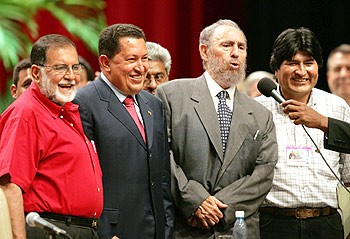
This post builds somewhat upon the post from last week on the joint Venezuelan/Russian naval exercise and some of the subsequent comments. I didn't bring this topic up in class today because I wanted to save it for the blog, so here goes.
A domestic political crisis in Bolivia seems to be exacerbating already rising tensions between the United States and several Latin American nations. The series of events that has led to the expulsion of ambassadors in both the northern and southern hemispheres began with a political squabble in the landlocked country.
Richer areas of Bolivia chafed at populist President Evo Morales' plans to redistribute oil wealth from their areas to poorer areas of the country and to establish a separate legal structure for Bolivia's indigenous majority (Morales is the first Bolivian president of indigenous descent). Opposition to these plans has evolved into open rebellion and clashes between the president's supporters and opponents had left 30 dead as of this past weekend.
The soft-spoken Morales accused the US of providing support for the anti-government forces and subsequently expelled Ambassador Phillip S. Goldberg (a career ambassador, DIP 777 students). Bombastic Venezuelan President Hugo Chavez, a Morales ally, expelled the US ambassador in Caracas in a show of solidarity with La Paz. Chavez also suggested that the US has taken steps to remove him from power as well (which it seems probably happened at least once with the 2002 coup attempt). The US has responded with the expulsion of both the Bolivian and Venezuelan envoys in Washington.
Leaders of Chile, Brazil, Argentina, Paraguay, Ecuador (and probably Uruguay and Peru, soon), and even staunchly pro-American Colombia have also expressed their solidarity with Morales in this affair.
Morales' list of complaints against the US include:
- meetings between Goldberg and anti-Morales governors on the eve of the rebellion
- a military attache at the US embassy having a relative smuggle a large quantity of .45 caliber ammunition into the country
- the revelation by an American Fulbright Scholar that an embassy official was attempting to get him/her as well as Peace Corps volunteers involved in intelligence gathering in Bolivia
- condescending behavior toward the Bolivian government by Goldberg
- Goldberg's posing for a photo with a Colombian paramilitary operative
Speaking of President Morales, this Daily Show interview of him was really odd...
Climate Change a Threat to National Security?

According to an Economist article entitled "Adapt Or Die," the public is coming to terms with the fact that global climate change cannot be reversed or ameliorated, but that it can start planning adaptation to a changing global climate. This July, the Senate reportedly set aside $20 million for "international adaptation efforts." While this sum and legislation is more of symbolic nature than an actual promising approach to the problem, it does show that mindsets are evolving towards coping with the problem and not trying to solve it. This past summer, the UN also dealt with the details of the first carbon tax for global adaptation.
Adaptation efforts derive from the realization that climate change cannot be stopped and that it hits the poorest of the poor. In the future, we can expect an increase in extreme weather (storms, drought, floods), rising temperatures and a rising sea level. This has a disproportionate impact on the poorest people on this earth and those in island states, about 1 billion in 100 countries, according to the article. It impacts what these people depend on the most: agriculture, fishing and tropical forests. Many poor nations see climate change as a problem of the wealthy nations that cause it, but nevertheless, they have to deal with its direct impact. They have to cope with a lack of money for reconstruction efforts and dependence on help for food and medical treatment of infectious diseases.
China, Brazil and India lead negotiations on climate change for the developing countries, but they have very different interests from the poorest developing nations because they are big polluters themselves. The Kyoto Protocol famously rewards industrial nations that cut their emissions, but there is no reward or incentive for the very poor, such as for good management of tropical forests.
Now this is all good, but the average American still seems skeptical about the direct impact of climate change on his life, except for maybe during hurricane season, which has been around for some time. Well, if droughts or floods cause civil strife and turmoil in developing nations and threaten state stability, this can cause anger with the billion poor and give incentive for hostile actions against industrial nations. This can affect U.S. citizens at home, influence U.S. military operations and heighten overall global tensions. A study conducted by a military panel in 2007 on
"National Security and the Threat of Climate Change," states that climate change "acts as a threat multiplier in already fragile regions of the world, creating the breeding grounds for extremism and terrorism." It points out that climate change can lead to an increased risk of mass migration, an increase in border tensions, conflicts over resources, and a possible increased expectation for direct U.S. military involvement. Thus, it will impact U.S. national security.
While it is too late to stop climate change, the U.S. should improve its effort to seriously try to adapt to the new global and national circumstances and to plan ahead in order to prevent foreseeable escalations in the future and to improve its national security.
Tuesday, September 16, 2008
EU Defense and The New World Order
An article in The Economist titled <“A Worrying New World Order”> poses the undeterminable question as to what position the European Union will obtain when a new world order emerges. No matter what the new world order has in store, it would be beneficial for the European Union to continue progress of the principle of the common foreign and security policy (CFSP) and the European Security and Defense Policy <(ESDP)>, a collective security principle and body within the EU, in order to enhance its influential role in the new world order. After the re-emergence of Russia during the Georgia-Russia conflict over the past few weeks this question has been heavily discussed across Europe. Some would argue that a new world order already exists and from that stems the decline of the United States as a hegemony. The article suggest that “A previous generation of EU leaders, such as Jacques Chirac or Gerhard Schroder, dreamt of a multi-polar world, in which several powers would wield clout.” However, this multi-polar system is not a certain outcome and one source suggests that “this is a neo-polar world, in which old alliances and rivalries are bumping up against each other in new ways.” Although this notion has little evidence to back it, the “neo-polar world” is identified more by what it is not.
The European Union has certainly evolved since the establishment of the European Steel and Coal Community in 1951. It has extended its influence across the continent by lowering trade barriers amongst members in order to create a common market, implementing a common currency for most of the members, and by acquiring more members which currently encompasses 27 countries. Overall, the EU has had tremendous success in uniting Europe, and in promoting a peaceful existence amongst members; however, there are modern-day challenges that inevitably face the EU and the institution will have to develop collective strategies to deal with them.
The national security challenges range on a spectrum from international terrorism to drug and human trafficking, issues that are essentially on the entire global west agenda. The EU has attempted to devise a common defense strategy encompassing decisive diplomacy and a military, but so far it has not been an overall success. This is due in part to the reservations that member governments are having in authorizing a set of policies that may be contradictive to domestic policies. These reservations are certainly valid, but it also goes to show that creating a completely unified set of standards can be a lengthy process; however, the clock is ticking and the new world system is slowly emerging. The sooner the EU can attain policy solidarity in the ESDP than the sooner it will be able to manage its own conflicts, gather as a single unified force, and reduce its heavy reliance upon other collective security institutions, thus, enabling it to gain even more credibility in the ever changing world order.
The European Union has certainly evolved since the establishment of the European Steel and Coal Community in 1951. It has extended its influence across the continent by lowering trade barriers amongst members in order to create a common market, implementing a common currency for most of the members, and by acquiring more members which currently encompasses 27 countries. Overall, the EU has had tremendous success in uniting Europe, and in promoting a peaceful existence amongst members; however, there are modern-day challenges that inevitably face the EU and the institution will have to develop collective strategies to deal with them.
The national security challenges range on a spectrum from international terrorism to drug and human trafficking, issues that are essentially on the entire global west agenda. The EU has attempted to devise a common defense strategy encompassing decisive diplomacy and a military, but so far it has not been an overall success. This is due in part to the reservations that member governments are having in authorizing a set of policies that may be contradictive to domestic policies. These reservations are certainly valid, but it also goes to show that creating a completely unified set of standards can be a lengthy process; however, the clock is ticking and the new world system is slowly emerging. The sooner the EU can attain policy solidarity in the ESDP than the sooner it will be able to manage its own conflicts, gather as a single unified force, and reduce its heavy reliance upon other collective security institutions, thus, enabling it to gain even more credibility in the ever changing world order.
Camoflauge: Tiger Stripes are SOOOOO Last Season

For decades most army fatigues, now referred to as battledress uniforms incorporated wiggly patterns of solid colors known as tiger stripes. However, researchers in the field of "clutter-metrics" (the study of how well observers isolate and identify objects) have recently discredited tiger stripes. The new look for this season, as determined by researchers, are uniforms consisting of "pixels" tiny blocks of color coordinated in patterns to blend with the environment around the soldier.
The research however does not stop there. Some camoflauge designers, including those at America's Army Research Lab also study the reflective and light absorbing properties of materials common to a combat area such as concrete, sand, etc. As a result of this research fabric inks are developed with the desired optical properties to enhance a soldier's invisibility.
An "Adaptive" camoflauge line that changes in response to the environment with the use of LED technology is also in the works but let's face it guys, while these battledress uniforms, may look "fabulous" on the runway, Micheal Kors and Nina Garcia would both agree, fabric made of LED material is simply not practical, it's just not ready-to-wear. However, i have no doubt that researchers will eventually find a way to "make it work." If last season tiger stripes were in, the future of camoflauge will take its inspiration from a more "chameleon" perspective.
And how might you ask, does the american soldier make that all important transition from daytime fashion to evening wear? Fabrics are now being developed to block human heat signatures and thus make them invisible to infrared detection devices. American soldiers may be heard on the battlefield at night but as far as visual detection, they will be next to invisible.
Development of this technology is perhaps in response to the now increasing availability of infrared technology. Such technology is becoming less expensive and is now so readily available that the Taliban in Afghanistan are well equipped with it. The U.S., one of the best at conducting operations at night, needs to stay one step ahead of the competition.
However, even as people become harder and harder to spot on the battlefield, new detection technologies are being developed. Radars for foliage penetration and radars which use cell phone signals to detect stealth aircraft are just a few examples. The race is on to perfect the art of being invisible, while at the same time developing technologies to make sure you can see everybody else. Making sure the enemy stays in the spotlight while you can in essence "fade to black"
With all of the money and development that is being poured into the arms race of concealment and detection, one would hope that the distribution of these technologies will not lag behind their development. Having a poncho that can be worn at night to hide your thermal imagery from a Taliban soldier surveying the area with an infrared camera is an excellent advantage. But what happens when this technology is too expensive to produce and distribute en mass to the soldiers that need it? The taliban soldier still has his infrared, but the american soldier is left unfortunately exposed. Such a fashion faux pas...
Our soldiers deserve more than substandard care
 U.S. soldiers put their lives on the line each day to defend their country. It is without question one of the most admirable careers a man or woman could choose. After enlisting, training, and for many of them, traveling overseas to threatening combat zones where they will witness atrocities that most can never imagine, they return home to a hero's welcome. The ideal situation is for a soldier to return home to their families and friends in good health, without injury. However, what about the soldiers who have paid the price of national security with their health, and have fallen victim to injury? These soldiers return home to seek medical care of what should be of the highest caliber, however, it has become obvious that not all VA medical facilities are providing such service.
 In February 2007, the country was rocked with the news that Walter Reed Army Medical Center was caring for veterans in substandard facilities, leaving people in shock. How could a medical center that should be equipped with state-of-the-art medical technology be providing substandard treatment to our nation's soldiers? This was completely unacceptable. Although blame was juggled around, Veteran Affairs vowed to correct the problem and provide the kind of treatment these soldiers deserved. Soldiers, their families, and the public were informed this type of crime against American soldiers would be corrected and not occur again. This has been far from the truth.
Surgeries at the VA medical facility in Marion, Illinois have been halted as a string of veteran deaths have occurred in the past year, which have been attributed to substandard care. If it isn't bad enough that the office of Veteran Affairs has not kept their word to not allow soldiers to be treated in substandard conditions, the employees responsible for providing the substandard care have not been held accountable. Illinois Representative Jerry Costello is currently trying to correct this by calling for criminal charges to be pressed against the employees involved.
This problem of substandard care for american veterans is not only an insult and embarrassment to the armed forces, but also serves as a hindrance to military recruitment. How can a country recruit the best and truthfully make the promises they do when they cannot assure the highest quality of treatment for veterans? We owe our veterans much more.
http://www.usatoday.com/news/health/2008-09-15-surgeon-deaths_N.htm
Monday, September 15, 2008
Centrifuges, Whirled Milk, & a Peaceful Iran

Centrifuges are utilized throughout the world for a multitude of peaceful purposes, like separating milk. However, they are most ominously utilized in the process of enriching uranium for the purposes of reactor fuel or weapons material. In fact, it is the quality and quantity of centrifuge(s) which dictates the rate and volume of enriched material output and enables stockpiling capabilities. Therefore, in accordance with the recent NY Times article, it is quite worrisome to note the recently declared efficiency gains made by Iran in regards to its centrifuge technology.
To begin, this revelation – if true – thrusts the world once more into worry over the now undeniable progression of an Iranian nuclear program. This ongoing development in international affairs is only exacerbated by a more confrontational Iran (following the leadership of Mahmud Amedinejahd) which appears at the moment to be manipulating the fear of nuclear armament as leverage in the expansion of influence and importance in the region. This system of diplomatic and political operating in itself is dangerous due to the potential of a renewed arms race, the prospect of a preemptive attack, and the chance of destabilization.
Perhaps more important, however, is the impact this technological development will have on the threat assessment produced by the United States in reference to Iran. With the increasing probability that Iran will soon have the capacity to produce weapons grade uranium (and produce in increasing volume), there will inevitably be a powerful shift in U.S. assessment and policy towards Iran to compensate for the burgeoning threat posed by a new, nuclear power in the Middle East.
This newest development will inevitably increase the tension in an already tenuous situation, and will hopefully generate a new pressure for multilateral negotiations, but will more likely expedite the danger of a volatile confrontation.
"Nuclear Agency Says Iran Has Improved Enrichment"
http://www.nytimes.com/2008/09/16/world/middleeast/16iran.html?_r=1&ref=world&oref=slogin
Saturday, September 13, 2008
DOD's Air Force Tanker Decision Is Just Another Example of the Air Force's Procurement Problems

The Department of Defense’s recent decision to cancel the current program replacing the Air Force’s aging fleet of airborne tankers is just another example of the problems of procurement within the Air Force and the DOD as a whole. A government auditor delivered a report to Congress in June describing the current state of procurement within the DOD. The auditor stated that the federal government spent $295 billion more than was expected on major US weapon systems in the previous fiscal year. Senator Carl Leven of Michigan said that this overrun was the “equivalent to two new aircraft carriers, eight attack submarines, 500 V-22 Ospreys, 500 Joint Strike Fighters, 10,000 mine-resistant armored vehicles and the Army's entire $130 billion Future Combat System program.” The result of these cost overruns means that more DOD programs will either be delayed or canceled altogether at a time when these programs are needed to replace aging and worn-out equipment.
The Air Force’s tanker replacement program first experienced problems in 2003 when the first plan to lease 100 Boeing 767s at a cost of $20 billion over 10 years was canceled by Congress. Then the Air Force decided to solicit bids for a replacement tanker, valued at $35 billion. Boeing and Northrop Grumman who worked with the European company EADS submitted two bids. While Northrop and EADS won the competition, Boeing filed a formal protest with the Government Accountability Office, which upheld their protest on the grounds that the competition was unfair and recommended that the competition be reopened. The replacement for the current fleet of aging tankers will now be delayed until at least next year once the new president is in office, unless any more unforeseen protests arise. All of these problems come at a time when the tanker replacement program has been named the #1 procurement priority of the Air Force.
If the Air Force, and the DOD, is going to fix these problems any time soon then it must realize that it can’t just keep throwing more money at programs thinking that it will solve their problems. All that it does is waste more of the tax payers’ money that could be better used on programs that we know are going to work. If the Air Force, or any branch of the military, is going to name a program their #1 priority, then you would think that they would put their best people on it and make sure that it was handled right. Let’s just hope that the DOD gets these problems figured out before our equipment starts to break down when we are called on to defend a NATO country from Russian aggression.
Wednesday, September 10, 2008
Venezuela and Russia
Apparently, in addition to sending over warships for exercises, Russia has decided to send over two strategic bombers for a similar purpose. A "strategic bomber," according to wikipedia, is a bomber capable of dropping lots of bombs on a distant target, like a city or military base. In other word, something that would be of only limited use in controlling "counter-revolutionaries" in Venezuela or even the "rightist" regime next door. This is apparently the same bomber that Russia uses for its long range patrols. This is a massive piece of engineering, far outside of anything Venezuela needs practice with for its conceivable threats.
So, why is it in Venezuela right now, if only for a few days? Well, Chavez himself might get to fly one. This seems to be deliberate provocation. To be fair, apparently Venezuela has a decent air force, and may currently lack training. However, bringing in a heavy bomber that you don't plan on selling to the country doesn't seem like a good way to train them. If they're running missions together, a less advanced (and less threatening) bomber would probably do just as well.
What is especially interesting is that, according to the same article, China has actually sold Chavez some airplanes. However, the Chinese ones are training and "light attack aircraft." In other words, China is letting Chavez have little piddly stuff that the US wouldn't worry about. They're also getting more back than Russia is.
The most unbelievable part, though, is Chavez's idea that this will bring about a "pluri-polar" world, and that it shows the end of "Yankee hegemony." A pair of Russian bombers in Venezuela for a few days, even with a few Russian ships near harbor, by no means show an end of American hegemony in the Western hemisphere. Perhaps the US will think twice before doing anything in Venezuela; you'd better believe Russia will think a lot more than twice before coming to Chavez's aid. If nothing else, Chavez is going out of his way to make this whole thing more provocative than it originally needed to be; I wonder how Russia feels about that? If they're just tweaking the US, then it might make sense. Otherwise, they (like us before) might want to think about the wisdom of allying with crazy people.
So, why is it in Venezuela right now, if only for a few days? Well, Chavez himself might get to fly one. This seems to be deliberate provocation. To be fair, apparently Venezuela has a decent air force, and may currently lack training. However, bringing in a heavy bomber that you don't plan on selling to the country doesn't seem like a good way to train them. If they're running missions together, a less advanced (and less threatening) bomber would probably do just as well.
What is especially interesting is that, according to the same article, China has actually sold Chavez some airplanes. However, the Chinese ones are training and "light attack aircraft." In other words, China is letting Chavez have little piddly stuff that the US wouldn't worry about. They're also getting more back than Russia is.
The most unbelievable part, though, is Chavez's idea that this will bring about a "pluri-polar" world, and that it shows the end of "Yankee hegemony." A pair of Russian bombers in Venezuela for a few days, even with a few Russian ships near harbor, by no means show an end of American hegemony in the Western hemisphere. Perhaps the US will think twice before doing anything in Venezuela; you'd better believe Russia will think a lot more than twice before coming to Chavez's aid. If nothing else, Chavez is going out of his way to make this whole thing more provocative than it originally needed to be; I wonder how Russia feels about that? If they're just tweaking the US, then it might make sense. Otherwise, they (like us before) might want to think about the wisdom of allying with crazy people.
Homegrown Terrorism in the US: Still a Threat?

A recent FBI report on Neo-Nazi attempts to recruit from within the US military and to send existing group members into the military to train for future "race wars" highlights the issue of domestic terrorism in the United States. A little over a decade ago, following the Oklahoma City Bombings, domestic terrorism was the issue of the day. Far-right wing domestic extremism was also brought to the fore during the 90s by two other dramatic events: confrontations between federal agents and the Weaver family in Ruby Ridge, Idaho and Branch Davidian followers of David Koresh in Waco, Texas.
I also remember lots of news reports during the 90s (even though I was just a little kid) about conspiracy-minded non-government sanctioned militias (most notably the Michigan Militia) stockpiling weapons and training in preparation for, I dunno, the arrival of black helicopters or some such. My understanding of the situation is that most of these groups kind of lost their cache and their fervor after 2000 with the election of President Bush, who had views more in line with theirs.
This FBI report is, to me, a reminder that domestic terrorism is still an issue in the United States. It is difficult to tell whether the media's shift away from reporting on such groups since the 90s is a result of the decline of these organizations, a shift toward reporting on international terrorism since 9/11, or some combination of the two.
If you're interested in keeping tabs on these sorts of issues, the Southern Poverty Law Center's Intelligence Project is the only source that I'm aware of tracking and reporting on white nationalist, neoconfederate, Christian identity, black separatist, & other extremist groups in the US. They even have a cool interactive map that lets you track hate groups in your home state!
Tuesday, September 09, 2008
Are Fantasies a Detriment to National Security?
Clearly, in order to answer this, one must have a clear understanding of our national interest…what must we secure. Would it be in our national interest then to lose more money than the budget for the city of San Francisco with nothing to show for it in the end? Most would say “no”.
 In a side-splitting article in the most recent Sports Illustrated, Chris Ballard cited an August report from a Chicago research group that showed that US employers lose more than Jamaica’s GNP during the 17 week regular season of the National Football League. “Hey mon” you say, who is the culprit. Well, possibly you. If you recently drafted a roster of players that you will never meet, pay, or interact with, and you refer to them as “your” team, than you are the problem. Fantasy football owners will cost their employers more than $9.2 Billion (BILLION!!!) dollars in lost work over the season (according to Ballard, you could also buy 9 NFL franchises for that amount).
 Fantasy football is not alone. Fantasy sports are participated in by fans around the nation in nearly every popular American sport…Baseball, Basketball, Golf, NASCAR, and flipcup (OK, maybe not). In the much shorter three week period of the NCAA Basketball Tournament, fans truly go ‘mad’. In March of every year, fans slip away to check scores, research teams, and fill out their brackets for office polls. Experts argue that more than $3.8 Billion is lost by US employers from the day the NCAA Selection Committee publishes its bracket until the morning after the Championship game. By dividing the loss to employers by the weeks in which the loss takes place, March Madness (or the NCAA Tournament for those that aren’t afflicted by the addiction) trumps Fantasy Football at more than $1.26 Billion per week in lost revenue.
 The Olympics also had a huge impact on employers. According to Neilson Online, more than 2 million people visited the video section of www.nbcolympics.com on Aug. 11 -- the first full day of work after the Olympics began. Yahoo!'s Olympic Web site's visitors were up 86 percent in the same time period.
This argument has less to do with America’s addiction to football, and the fantasy fallout of that sport than it does with efficiency in the workplace. Surely, employers lost serious bank while American fixated on media outlets showing the play-by-play assault on Baghdad in 2003. Without fail, Governor Palin has already impacted employers as Americans try to answer the questions, “Who is she?” and “Are there any better pics on Google images?” The election year will certainly affect the employers.
In pure National Security terms, $9.2 and $3.8 billion are hardly a drop in the bucket of the Department of Defense’s $440 billion budget or the $170 billion in extra-budgetary supplements used to help pay for the wars in Iraq and Afghanistan. But, when you break down the defense budget, the nation will spend less this year on Missile Defense ($8.8 B), the Joint Strike Fighter ($6.1 B), Future Combat Systems ($3.7 B), and the Navy’s Littoral Combat Ships ($1.2 B) than one might estimate is being wasted by Americans and their online games. Though it may be hard to translate a loss by US employers into National Security and defense funding, it goes without saying that Jamaica might want to do its very best to deter its citizens from becoming so infatuated with these distractions.

If the US populace is affected this greatly by fantasy sports, March Madness, and the news in general, one must wonder how it affects soldiers who are operating in combat or in defense of the nation. I can only imagine a Commander in his command post switching windows on his PC when no-one is watching so that he can drop Tom Brady from his roster and add one of Week 1’s rookie heroes. (Perhaps someone on the blog can address this?)

 In a side-splitting article in the most recent Sports Illustrated, Chris Ballard cited an August report from a Chicago research group that showed that US employers lose more than Jamaica’s GNP during the 17 week regular season of the National Football League. “Hey mon” you say, who is the culprit. Well, possibly you. If you recently drafted a roster of players that you will never meet, pay, or interact with, and you refer to them as “your” team, than you are the problem. Fantasy football owners will cost their employers more than $9.2 Billion (BILLION!!!) dollars in lost work over the season (according to Ballard, you could also buy 9 NFL franchises for that amount).
 Fantasy football is not alone. Fantasy sports are participated in by fans around the nation in nearly every popular American sport…Baseball, Basketball, Golf, NASCAR, and flipcup (OK, maybe not). In the much shorter three week period of the NCAA Basketball Tournament, fans truly go ‘mad’. In March of every year, fans slip away to check scores, research teams, and fill out their brackets for office polls. Experts argue that more than $3.8 Billion is lost by US employers from the day the NCAA Selection Committee publishes its bracket until the morning after the Championship game. By dividing the loss to employers by the weeks in which the loss takes place, March Madness (or the NCAA Tournament for those that aren’t afflicted by the addiction) trumps Fantasy Football at more than $1.26 Billion per week in lost revenue.
 The Olympics also had a huge impact on employers. According to Neilson Online, more than 2 million people visited the video section of www.nbcolympics.com on Aug. 11 -- the first full day of work after the Olympics began. Yahoo!'s Olympic Web site's visitors were up 86 percent in the same time period.
This argument has less to do with America’s addiction to football, and the fantasy fallout of that sport than it does with efficiency in the workplace. Surely, employers lost serious bank while American fixated on media outlets showing the play-by-play assault on Baghdad in 2003. Without fail, Governor Palin has already impacted employers as Americans try to answer the questions, “Who is she?” and “Are there any better pics on Google images?” The election year will certainly affect the employers.
In pure National Security terms, $9.2 and $3.8 billion are hardly a drop in the bucket of the Department of Defense’s $440 billion budget or the $170 billion in extra-budgetary supplements used to help pay for the wars in Iraq and Afghanistan. But, when you break down the defense budget, the nation will spend less this year on Missile Defense ($8.8 B), the Joint Strike Fighter ($6.1 B), Future Combat Systems ($3.7 B), and the Navy’s Littoral Combat Ships ($1.2 B) than one might estimate is being wasted by Americans and their online games. Though it may be hard to translate a loss by US employers into National Security and defense funding, it goes without saying that Jamaica might want to do its very best to deter its citizens from becoming so infatuated with these distractions.

If the US populace is affected this greatly by fantasy sports, March Madness, and the news in general, one must wonder how it affects soldiers who are operating in combat or in defense of the nation. I can only imagine a Commander in his command post switching windows on his PC when no-one is watching so that he can drop Tom Brady from his roster and add one of Week 1’s rookie heroes. (Perhaps someone on the blog can address this?)
Who knows, maybe the President even spends his valuable time studying for the fantasy draft and shuffling his lineup week to week in order to best match up with his opponents…Dick, Donnie, Condi, who knows? But if he does, then even if it wasn’t before, it is surely a problem of National Security now. http://www.sportspickle.com/features/volume2/2003-0903-bush.html
Something is Wrong in North Korea
Sources in South Korea's embassy in China are verifying claims that Kim Jong-Il collapsed on August 22nd. He has not been seen in public for nearly a month and was conspicuously absent from a militaristic display celebrating the 60th anniversary of the DPRK.
This development comes at the same time a former Japanese intel officer claims that Kim died in 2003 and has 4 body doubles. Rumors like these are usually based off inabilities to explain incongruent events. The existence of these rumors in such close proximity point to something developing in the North concerning Kim Jong-Il.
The innocent explanation of Kim's absence from the parade (which he attended in 1998 and 2003) is, according to one analyst, " He has nothing to show his people, with a deadlock in nuclear disarmament talks and in normalisation talks with Japan on top of food shortages."
The explanation that Kim Jong-Il has actually died, or is in serious condition, is bolstered by two additional facts: 1) A team of Chinese doctors were dispatched to the DPRK around the time of Kim's reported collapse and have yet to return 2) North Korea's recent rhetoric concerning the six-party talks, disarmament, and rebuilding the Yongbyon reactor.
The official statement from North's foreign ministry criticized the 'verification requirement' as an unjust demand. They made a counter-demand of verification that no nuclear weapons are in South Korea and assurances that U.S. will not send them there. Most telling, they invoked the term 'nuclear deterrent' for only the second time since 2006. The state-run media has used the term 'war deterrent' numerous times - in comparison with sparse prior mentions - since the date of Kim's reported collapse (possibly a stroke, or complications with his diabetes).
The 'spokesman statement' from the North also mentioned that steps concerning the rebuilding of the Yongbyon reactor will take into account the demands of relevant North Korean agencies. In 2002, a concrete statement was issued in which no consideration was given to 'multiple or competing voices within the regime' in regards to nuclear activities.
These considerations lend credence to rumors that something is wrong in North Korea. There is no heir-apparent and North Korean leaders are aware of that a crisis in leadership could present and opening for the toppling of their government by Western interests. The rhetoric on the reactor, and invoking a 'nuclear deterrent', could well be their attempts at deterring the West while they are in the midst of a crisis.
Why would they derail the talks? Why invoke the strong language of 'nuclear deterrent'? Why issue a statement that mentions different, possible dissenting voices within the power structures of the government? Kim Jong-Il has given no such consideration to other agencies of the government and their wishes. If he is still running North Korea at the moment, these statements represent a departure from his past behavior and his style of governing.
This development comes at the same time a former Japanese intel officer claims that Kim died in 2003 and has 4 body doubles. Rumors like these are usually based off inabilities to explain incongruent events. The existence of these rumors in such close proximity point to something developing in the North concerning Kim Jong-Il.
The innocent explanation of Kim's absence from the parade (which he attended in 1998 and 2003) is, according to one analyst, " He has nothing to show his people, with a deadlock in nuclear disarmament talks and in normalisation talks with Japan on top of food shortages."
The explanation that Kim Jong-Il has actually died, or is in serious condition, is bolstered by two additional facts: 1) A team of Chinese doctors were dispatched to the DPRK around the time of Kim's reported collapse and have yet to return 2) North Korea's recent rhetoric concerning the six-party talks, disarmament, and rebuilding the Yongbyon reactor.
The official statement from North's foreign ministry criticized the 'verification requirement' as an unjust demand. They made a counter-demand of verification that no nuclear weapons are in South Korea and assurances that U.S. will not send them there. Most telling, they invoked the term 'nuclear deterrent' for only the second time since 2006. The state-run media has used the term 'war deterrent' numerous times - in comparison with sparse prior mentions - since the date of Kim's reported collapse (possibly a stroke, or complications with his diabetes).
The 'spokesman statement' from the North also mentioned that steps concerning the rebuilding of the Yongbyon reactor will take into account the demands of relevant North Korean agencies. In 2002, a concrete statement was issued in which no consideration was given to 'multiple or competing voices within the regime' in regards to nuclear activities.
These considerations lend credence to rumors that something is wrong in North Korea. There is no heir-apparent and North Korean leaders are aware of that a crisis in leadership could present and opening for the toppling of their government by Western interests. The rhetoric on the reactor, and invoking a 'nuclear deterrent', could well be their attempts at deterring the West while they are in the midst of a crisis.
Why would they derail the talks? Why invoke the strong language of 'nuclear deterrent'? Why issue a statement that mentions different, possible dissenting voices within the power structures of the government? Kim Jong-Il has given no such consideration to other agencies of the government and their wishes. If he is still running North Korea at the moment, these statements represent a departure from his past behavior and his style of governing.
National Security: Memo to the Next President


Eric Rosenbach, executive director of research at Harvard Kennedy School's Belfer Center for Science and International Affairs and former staff member of the Senate Intelligence Committee, was interviewed about his opinion on what the next president of the United States should concentrate on when confronted with U.S. national security and intelligence capabilities (Interview). Essentially he said, whoever wins the election will have to learn from the last eight years of the Bush administration and do many things differently.
First, Rosenbach claims that a reorganization of the intelligence community simply does not solve any problems. The recent reorganization of 2004 led to a reshuffling of the cards, but really only caused chaos. He recommends the next president not to focus on reorganization, but to develop strong leaders within the intelligence community that do their job instead of worrying about organizational novelties. Thus, Rosenbach claims the reorganization of the intelligence community has been more disturbing than productive.
Second, in the interview Rosenbach states that the National Counterterrorism Center (NCTC) created in 2004, which was established as a coordination and collaboration platform for all intelligence communities, has not reached its full potential. It still lacks the ability to develop efficient "strategic policy planning" and focuses too much on the detailed tracking of terrorists, than on the greater picture. Also, information sharing is still not fully established, especially on the state and local levels, and the NCTC collaboration with the CIA needs strengthening in order to discover and analyze new threats.
Further, with oil prices skyrocketing, Rosenbach claims that the public has to expand its view of the intelligence community and see that it also serves to detect new threats that derive from energy shortages and crises and from the impact that climate change has on national security. If the public realizes that these are also issues on the agenda of the intelligence community, it will realize that the intelligence community's purpose is not limited to fighting terrorism and people might feel a stronger connection to it in their everyday lives.
In addition, Rosenbach advises the next president to work closely with allies on counterterrorism. Continuing close relationships with foreign intelligence services is essential in order for the U.S. to have access to a wider range of information. However, he also states that it is important for the U.S. to constantly be open to new partners in the field so it can keep evolving its knowledge and perfecting its counterterrorism capabilities.
In conclusion however, Rosenbach thinks that the U.S. intelligence community has significantly improved its abilities since 9/11. It is now able to "track down" dangerous enemies of the United States and analysis capabilities are also better than pre-9/11. He uses the recent Iran National Intelligence Estimate (NIE) to indicate how much the intelligence community's abilities have improved compared to the Iraq NIE from a few years ago.
Overall, I think whoever the next president will be, he should utilize the intelligence community platform established in the post-9/11 era and try to make it more efficient and not let organizational superficialities get in the way of efficient collection and analysis. And he should also be willing to listen to experts in the field.
Thursday, September 04, 2008
Your Hummer is Making the US Less Secure (in additon to making you look like a tool)

Former UN ambassador Richard Holbrooke recently asserted in an article in Foreign Affairs that, with the recent rise in energy prices, we are experiencing "the greatest transfer of wealth from one set of nations to another in history."
The transferers (read: suckers) in this case are the major oil consumers: the US, Europe, China, Japan & India. And the transferees are the major oil exporting nations. Seems all well & good--the producers have a product that the consumers want, so they sell it, get rich, & everybody's happy.
Unfortunately, it ain't that simple.
The rub here is, of course, that many of the states growing fat off the global spike in energy prices are home to unsavory regimes with, in many cases, foreign policy goals antithetical to those of the major consumers (especially those of the US, Europe, & Japan). And the recipients of the oil-gluttonous countries' cash, clearly aware of their
 increased clout, are exhibiting a dangerous new swagger on the world stage. Witness Mahmoud Ahmadinejad flouting western attempts to reign in Iran's nuclear ambitions, Hugo Chavez threatening Colombia and calling out President Bush in front of the UN General Assembly, & Vladimir Putin generally stirring shit up in the Caucasus.
So, the logical solution here would be to stop using so much foreign energy. The American political establishment seems to have reached consensus on this--the buzzword of the day being "energy security." Democrats urge us to wear sweaters, inflate our tires, & build windmills, while Republicans exhort us to "drill, baby, drill" (seemingly oblivious to the global nature of hydrocarbon markets).
Of course, any steps taken toward these goals will probably be all for naught if the emerging economies in India & China develop rates of energy consumption approaching those in the wealthy west and the petro-pushers simply shift to a new set of energy-junky clients.

So, what's the solution here? A major decrease in foreign oil consumption by wealthy countries with high consumption rates coupled with some sort of major assistance program designed to help emerging economies develop in a less energy-consumptive manner seems like the only solution from my vantage point.
This problem is huge, pressing, & has been seemingly ignored for the past few decades. And we're not even delving into the environmental impact of the current worldwide energy regime & global climate change...
Tuesday, September 02, 2008
Culture Drives the National Interest
Arnold Wolfers makes it clear in "National Security" As an Ambiguous Symbol, that "numerous domestic factors such as national character, tradition, preferences and prejudices will influence the level of security which a nation chooses to make its target". By analyzing American culture, it is readily apparent that a high level of national security will always remain a key tenet of the American national interest.
Though some may argue that democracies should not be violent in nature, it is imperative to realize that though there may be a paucity of wars amongst democracies, that democratic societies themselves are often violent. With this in mind, we should take a look at our own society. In doing so, it readily becomes clear that security is upheld as our most critical national interest by our character, traditions, and our preferences.

 We are a nation that emerged as a result of a violent revolution. That revolution is glorified in our history books, movies, and folklore. Our society upholds the heroes of the revolution, and carries forth from that era a belief that weapons are integral to the security of our homes and our nation. Furthermore, the American frontier was also won through struggle. The violent expansion westward was made possible in many ways by the right to bear arms.
With violence, comes the need for security. Americans are not only violent in their dealings with the outside world. The American culture embraces violence in nearly every part of society: sports, movies, musical lyrics, and video games. In The Clash with Distant Cultures (1995), Richard Payne cites numerous staggering statistics that depict the American tendency toward violence.
- 1991 poll: 72% of Americans believe force is appropriate to maintain international justice, whereas, 70% of Japanese feel it is inappropriate
- 400,000 students carried weapons to school...in 1987!
- 66 Million loaded weapons reported in American homes...for the purpose of security
- Gun accessibility - only 75 of 35,000 license requests denied in 1990.
- Murder rates (reflects use of violence to solve problems, per 100,000 citizens -1998 stats) US – 8.4, Canada – 5.5, Germany – 4.2, UK – 2.0, Japan – 0.8
- Average 16 year old has witnessed more than 200,000 acts of violence
When cultural values and norms reflect a nature of violence and an emphais for security against that violence, it is only logical that a nation immersed in violence will be more liklely to hold security as a supreme national interest. The reality is that culture, not realism, accounts largely for the American tendency to place national security as the main focus in terms of national interest.
Sunday, August 31, 2008
Evolution of Cyberspace, What Does This Mean for National Security?
http://www.nytimes.com/2008/08/30/business/30pipes.html?th&emc=th
I found this article from The New York Times to be interesting because it highlights some of the issues stemming from the global evolution of the internet in the 21st century, especially those pertaining to the undeterminable affects this has on national security. The article notes that the U. S. intelligence community has not placed a heavy emphasis on acquiring more knowledge about the effects that the internet could possibly have on national security mainly because it hasn’t really had to. Since 1998, the United States has carried “70 percent of the world’s Internet traffic”; however, a recent estimate shows the U.S. currently carrying only around “25 percent”.
Now that this revolutionary invention has spread rapidly all over the world, and continues to do so, it seems that the intelligence community will have no other option than to gather more information pertaining to the relationship of the net and national security. More exclusively, what role will the use of the internet play in terrorism? John Arquilla, a professor at the Naval Postgraduate School in Monterey, CA, claims that “We’ve given terrorists a free ride in cyberspace.” If so, what actions will the government take to eliminate this “free ride”, if any?
I found this article from The New York Times to be interesting because it highlights some of the issues stemming from the global evolution of the internet in the 21st century, especially those pertaining to the undeterminable affects this has on national security. The article notes that the U. S. intelligence community has not placed a heavy emphasis on acquiring more knowledge about the effects that the internet could possibly have on national security mainly because it hasn’t really had to. Since 1998, the United States has carried “70 percent of the world’s Internet traffic”; however, a recent estimate shows the U.S. currently carrying only around “25 percent”.
Now that this revolutionary invention has spread rapidly all over the world, and continues to do so, it seems that the intelligence community will have no other option than to gather more information pertaining to the relationship of the net and national security. More exclusively, what role will the use of the internet play in terrorism? John Arquilla, a professor at the Naval Postgraduate School in Monterey, CA, claims that “We’ve given terrorists a free ride in cyberspace.” If so, what actions will the government take to eliminate this “free ride”, if any?
Saturday, August 30, 2008
Presentation Schedule
Here's the provisional schedule:
2- Frost
3- Waddell, Alaina Stephens
4- Mains, Beineke
5- Willett, Crawford
6- Laura Stephens
7- Chami
8- Feeney
9- Sewell, Barker
10- Rush
11- Reed
12- McKinney
13- Smith
Let me know if there are any problems, or if I skipped anyone.
2- Frost
3- Waddell, Alaina Stephens
4- Mains, Beineke
5- Willett, Crawford
6- Laura Stephens
7- Chami
8- Feeney
9- Sewell, Barker
10- Rush
11- Reed
12- McKinney
13- Smith
Let me know if there are any problems, or if I skipped anyone.
Friday, August 29, 2008
Deterring America
Why do wars, which are costly for both sides, continue to occur? In looking for a rationalist explanation, James Fearon concluded that rational, cost-benefit analysis can break down because one side has information the other side does not and that there are incentives to misrepresent your capabilites and/or willingness to fight.
Why did the U.S invade Iraq when there existed a wide range of less costly compromises that were acceptable to both sides? It is obvious that Sadam adopted a risky strategy. He decided to misrepresent Iraq's capabilites vis-a-vis their nuclear weapons program. However, even if he had not done so, there are a variety of other reasons that the cost-benefit analysis on the U.S. side would have failed.
It is almost fair to say Benefit was seen as great (Cheney's comments of the amount of oil that would enter the world market soon after toppling the Iraqi regime) and Cost was seen as next to zero. The analysis failed - the costs were not accurately assessed. The number of troops it would take, the time commitment, the complicated Iraqi political environment, and the domestic political costs. Would conciliatory measures on Sadam's part deterred a U.S. invasion? Nothing short of going into exile would have shifted the distorted cost-benefit picture of the U.S. administration to an alternative other than war.
Is Iran willing to misrepresent its capabilities and suffer a similar fate as Iraq? When U.S. rhetoric has pushed for regime change at the same time for an end to a nuclear program - we are in effect saying " Please get rid of the only thing that makes us worry about you so that we can then get rid of you."
In studying when deterrents actually work, Russet and Huth made two conclusions (among others):
- Excessively conciliatory bargaining behavior undermines credibility and therefore, deterrence.
- Excessively hostile threats provoke hostile responses and trigger an upward spiral of escalation
Regarding the second conclusion, we must take into account the domestic political atmosphere in which Ahmadinejad operates. Plenty of studies say the Iranian population is West-ward looking and don't want confrontation. However, excessively hostile rhetoric could lead them to feel isolated and threatened - therefore sending their support behind a leader who will protect them.
Regarding the first - at the end of the day there are may nations who do not want to see a nuclear Iran and there are many avenues of pressure to pursue given enough political capital in Washington. There is no international capital there to spend now. A new administration would have some and bargaining, in this situation, does not hold the risk of undermining credibility. We stand to lose nothing through a dialogue. If it doesn't work, there are always the bombs.
Why did the U.S invade Iraq when there existed a wide range of less costly compromises that were acceptable to both sides? It is obvious that Sadam adopted a risky strategy. He decided to misrepresent Iraq's capabilites vis-a-vis their nuclear weapons program. However, even if he had not done so, there are a variety of other reasons that the cost-benefit analysis on the U.S. side would have failed.
It is almost fair to say Benefit was seen as great (Cheney's comments of the amount of oil that would enter the world market soon after toppling the Iraqi regime) and Cost was seen as next to zero. The analysis failed - the costs were not accurately assessed. The number of troops it would take, the time commitment, the complicated Iraqi political environment, and the domestic political costs. Would conciliatory measures on Sadam's part deterred a U.S. invasion? Nothing short of going into exile would have shifted the distorted cost-benefit picture of the U.S. administration to an alternative other than war.
Is Iran willing to misrepresent its capabilities and suffer a similar fate as Iraq? When U.S. rhetoric has pushed for regime change at the same time for an end to a nuclear program - we are in effect saying " Please get rid of the only thing that makes us worry about you so that we can then get rid of you."
In studying when deterrents actually work, Russet and Huth made two conclusions (among others):
- Excessively conciliatory bargaining behavior undermines credibility and therefore, deterrence.
- Excessively hostile threats provoke hostile responses and trigger an upward spiral of escalation
Regarding the second conclusion, we must take into account the domestic political atmosphere in which Ahmadinejad operates. Plenty of studies say the Iranian population is West-ward looking and don't want confrontation. However, excessively hostile rhetoric could lead them to feel isolated and threatened - therefore sending their support behind a leader who will protect them.
Regarding the first - at the end of the day there are may nations who do not want to see a nuclear Iran and there are many avenues of pressure to pursue given enough political capital in Washington. There is no international capital there to spend now. A new administration would have some and bargaining, in this situation, does not hold the risk of undermining credibility. We stand to lose nothing through a dialogue. If it doesn't work, there are always the bombs.
Thursday, August 28, 2008
Response to Obesity Post
This is in response to this post, just a few below this one.
Interesting idea, but your comments brought to mind many questions that you don't address. Where does my body end and the "National Interest" begin? You bring up an interesting point, but do you really think that a politician advocating healthy eating will do anything to stem obesity? And isn't it my right as a person to eat whatever I please? We aren't talking about food terrorism here, if I eat a pint of ice cream every night sitting on my couch, who is that hurting besides me? My size doesn't affect the national interest, does it? Don't I have the right to eat what I choose, even if it's unhealthy? Does the government have a right to step in?
It's not about food education. The government builds food pyramids, it gives awards for presidential fitness, it (as Dr Farley pointed out in his comment) created some national health initiatives to increase the fitness of our military, but obesity is still on the rise. Why? Because the kind of eating that creates morbid obesity doesn't have anything to do with logic. I'm sure that the majority of the obese people in this country know that they are unhealthy, know that they eat the wrong foods and know what they should be doing even though they don't. They know they should exercise more but "just don't feel like it" and no amount of education or advocation by the government or political candidates will make people get up off the couch.
Obesity isn't a result of ignorance. People aren't overweight because they don't realize that french fries and cheesecake are fattening. Believe me, they know. Just like smokers know that cigarettes are bad, alcoholics know that alcohol can ruin lives, and heroin addicts know that their drug of choice may kill them. These problems can't be solved by logic.
If the government does see obesity (and other addictions like smoking, alcohol and drugs) as true issues of national security, then the government must decide the amount of resources and type of resources to solve the problem. The government may need to create deterrents, or help to fund counseling for these addictions. The US does not currently have a national health system (though that may change depending on the outcome in November) but some European countries do. In the UK, a debate has begun over whether the National Health Service can deny medical treatment to people who live unhealthy lifestyles. This article mentions the idea of the government providing cash incentives to people to lose weight so as to not become too much of a burden on the state health service. Although the obesity rate in the UK isn't as high as the US, it is the highest in Europe. British taxpayers spend £7 billion a year due to obesity. Because this is a "self-inflicted" condition, does the NHS have the right to deny them care?
And at what point do we allow the national values to dictate how we citizens live our lives? Some may see obesity as a drain on resources, a health risk, or creating a "bad image" for the US abroad, but if I am happy being overweight do I have the responsibility to change my lifestyle so that my country can appear better to foreigners? Should the US create a nanny state that limits what type of foods I can ingest, or punishes me for eating too much?
As mentioned in class, national interests require trade-offs. Are Americans willing to give up the freedom to eat what they want?
Interesting idea, but your comments brought to mind many questions that you don't address. Where does my body end and the "National Interest" begin? You bring up an interesting point, but do you really think that a politician advocating healthy eating will do anything to stem obesity? And isn't it my right as a person to eat whatever I please? We aren't talking about food terrorism here, if I eat a pint of ice cream every night sitting on my couch, who is that hurting besides me? My size doesn't affect the national interest, does it? Don't I have the right to eat what I choose, even if it's unhealthy? Does the government have a right to step in?
It's not about food education. The government builds food pyramids, it gives awards for presidential fitness, it (as Dr Farley pointed out in his comment) created some national health initiatives to increase the fitness of our military, but obesity is still on the rise. Why? Because the kind of eating that creates morbid obesity doesn't have anything to do with logic. I'm sure that the majority of the obese people in this country know that they are unhealthy, know that they eat the wrong foods and know what they should be doing even though they don't. They know they should exercise more but "just don't feel like it" and no amount of education or advocation by the government or political candidates will make people get up off the couch.
Obesity isn't a result of ignorance. People aren't overweight because they don't realize that french fries and cheesecake are fattening. Believe me, they know. Just like smokers know that cigarettes are bad, alcoholics know that alcohol can ruin lives, and heroin addicts know that their drug of choice may kill them. These problems can't be solved by logic.
If the government does see obesity (and other addictions like smoking, alcohol and drugs) as true issues of national security, then the government must decide the amount of resources and type of resources to solve the problem. The government may need to create deterrents, or help to fund counseling for these addictions. The US does not currently have a national health system (though that may change depending on the outcome in November) but some European countries do. In the UK, a debate has begun over whether the National Health Service can deny medical treatment to people who live unhealthy lifestyles. This article mentions the idea of the government providing cash incentives to people to lose weight so as to not become too much of a burden on the state health service. Although the obesity rate in the UK isn't as high as the US, it is the highest in Europe. British taxpayers spend £7 billion a year due to obesity. Because this is a "self-inflicted" condition, does the NHS have the right to deny them care?
And at what point do we allow the national values to dictate how we citizens live our lives? Some may see obesity as a drain on resources, a health risk, or creating a "bad image" for the US abroad, but if I am happy being overweight do I have the responsibility to change my lifestyle so that my country can appear better to foreigners? Should the US create a nanny state that limits what type of foods I can ingest, or punishes me for eating too much?
As mentioned in class, national interests require trade-offs. Are Americans willing to give up the freedom to eat what they want?
As someone mentioned in class...
Here is the Chinese response to the Russian attack on Georgia. The Shanghai Cooperation Organization officially supported Russia's role in bringing stability to the region, but also came down sharply on maintaining the territorial integrity of the region. Meaning: No Separatism!
Beijing fully supports the notions of both sovereignty and territorial integrity. It has been fighting for decades to increase support for the norm of sovereignty over that of self-determination. Of course, it has a lot to lose from self-determination: about half of its land mass would probably leave. At the same time, no one doubts that the Chinese military COULD do the same things that the Russian military just did. Instead, though, China wants to build public support world-wide for its stands.
I think in the long run, the Chinese path will work out better than the Russian one.
Beijing fully supports the notions of both sovereignty and territorial integrity. It has been fighting for decades to increase support for the norm of sovereignty over that of self-determination. Of course, it has a lot to lose from self-determination: about half of its land mass would probably leave. At the same time, no one doubts that the Chinese military COULD do the same things that the Russian military just did. Instead, though, China wants to build public support world-wide for its stands.
I think in the long run, the Chinese path will work out better than the Russian one.
Curbing Obesity, Is It In Our National Interest?
These days, it is hard to flip through the channels of the television without coming across the next greatest “diet and exercise plan” being marketed in an infomercial. Further, the media is always investing time in preparing informative news articles and conducting interviews concerning obesity in the United States. Even primetime television airs shows such as The Biggest Loser in hopes to motivate our society to be ever more conscious of their health. However, throughout the 2008 Presidential Campaign we have heard politicians on both sides discuss stringent issues from the war in Iraq, to healthcare, to the economic decline. However, these politicians have managed to neglect one of the most popular topics currently discussed—obesity—which is not only affecting adults, but an overwhelming number of youth.
In fact, according to research conducted by the American Academy of Child and Adolescent Psychiatry, “Between 16 and 33 percent of children and adolescents are obese.” In adults, the percentages are even higher. Does this not flip on a light bulb America? Obesity is not just about appearing overweight on the outside, but there are detrimental health effects that are related to this epidemic. Some research shows the health effects from obesity are even worse than those from smoking, drinking, and poverty. Diabetes, Hypertension, Osteoarthritis, and Coronary Heart Disease are all diseases linked to obesity just to name few. So, my question is, should curbing obesity be in our national interest?
Politicians always seem to be concerned about the U.S. image abroad which essentially encompasses diverse components. Shouldn’t the appearance of U.S. visitors and vacationers abroad be considered by politicians to a greater degree than ever before? The appearance of U.S. visitors does essentially contribute to the image of the U.S. abroad especially in the twenty-first century when global travel is not just conducted by diplomats and businessmen, but even more so, by vacationers of the U.S. citizenry. I have traveled rather extensively and the overweight American society is one of the topics most forwardly addressed by foreigners. With the rise of over-seas leisure travel, altering the lifestyles of citizens to make them appear to be healthier would certainly be worthwhile to politicians concerning themselves with the U.S. image abroad.
With that being stated, the next step to consider is to what degree should the government play a role in tackling this disease? Implementing healthier food choices in public school lunch menus is certainly a feasible starting point especially regarding the youth; in fact, many local school districts throughout the nation have already taken this initiative. It would be wise for other local school districts to follow in their lead. To another extent, local politicians could promote fitness and dieting within the community alone. One Mayor has already implemented a program such as this in the city of Austin, Texas. Incidentally, it would be beneficial for more research to be conducted about the additives that are put in many of the foods being consumed. Chemicals from hormones to pesticides are put in various foods, could an overconsumption of these chemicals possibly be contributing to obesity?
In any event, if obesity is so critical, and that’s what medical doctors and researchers are telling us then why haven’t U.S. politicians addressed this topic? The movement to tackle obesity has already begun, but it is only in the early stages. A little political leadership assistance would not only help carry out the obesity initiative but it would also play an important role in promoting a healthier U.S. population at home and in the image of those abroad.
http://www.ci.austin.tx.us/fitness/
http://www.rand.org/pubs/research_briefs/RB4549/index1.html
http://www.aacap.org/cs/root/facts_for_families/obesity_in_children_and_teens
In fact, according to research conducted by the American Academy of Child and Adolescent Psychiatry, “Between 16 and 33 percent of children and adolescents are obese.” In adults, the percentages are even higher. Does this not flip on a light bulb America? Obesity is not just about appearing overweight on the outside, but there are detrimental health effects that are related to this epidemic. Some research shows the health effects from obesity are even worse than those from smoking, drinking, and poverty. Diabetes, Hypertension, Osteoarthritis, and Coronary Heart Disease are all diseases linked to obesity just to name few. So, my question is, should curbing obesity be in our national interest?
Politicians always seem to be concerned about the U.S. image abroad which essentially encompasses diverse components. Shouldn’t the appearance of U.S. visitors and vacationers abroad be considered by politicians to a greater degree than ever before? The appearance of U.S. visitors does essentially contribute to the image of the U.S. abroad especially in the twenty-first century when global travel is not just conducted by diplomats and businessmen, but even more so, by vacationers of the U.S. citizenry. I have traveled rather extensively and the overweight American society is one of the topics most forwardly addressed by foreigners. With the rise of over-seas leisure travel, altering the lifestyles of citizens to make them appear to be healthier would certainly be worthwhile to politicians concerning themselves with the U.S. image abroad.
With that being stated, the next step to consider is to what degree should the government play a role in tackling this disease? Implementing healthier food choices in public school lunch menus is certainly a feasible starting point especially regarding the youth; in fact, many local school districts throughout the nation have already taken this initiative. It would be wise for other local school districts to follow in their lead. To another extent, local politicians could promote fitness and dieting within the community alone. One Mayor has already implemented a program such as this in the city of Austin, Texas. Incidentally, it would be beneficial for more research to be conducted about the additives that are put in many of the foods being consumed. Chemicals from hormones to pesticides are put in various foods, could an overconsumption of these chemicals possibly be contributing to obesity?
In any event, if obesity is so critical, and that’s what medical doctors and researchers are telling us then why haven’t U.S. politicians addressed this topic? The movement to tackle obesity has already begun, but it is only in the early stages. A little political leadership assistance would not only help carry out the obesity initiative but it would also play an important role in promoting a healthier U.S. population at home and in the image of those abroad.
http://www.ci.austin.tx.us/fitness/
http://www.rand.org/pubs/research_briefs/RB4549/index1.html
http://www.aacap.org/cs/root/facts_for_families/obesity_in_children_and_teens
Democratic Platform
Apparently at least one libertarian blogger is somewhat worried about the following bit from the Democratic Party Platform:
"We believe we must also be willing to consider using military force in circumstances beyond self defense in order to provide for the common security that underpins global stability-to support friends, participate in stability and reconstruction operations, or confront mass atrocities."
Does't this just mean that the Democratic party believes that there are values of importance besides territorial integrity?
(Thanks to Andrew Sullivan for mentioning it.)
"We believe we must also be willing to consider using military force in circumstances beyond self defense in order to provide for the common security that underpins global stability-to support friends, participate in stability and reconstruction operations, or confront mass atrocities."
Does't this just mean that the Democratic party believes that there are values of importance besides territorial integrity?
(Thanks to Andrew Sullivan for mentioning it.)
Deterrence and the Current Candidates
I might be mistaken, but it dawned on me this morning that I've not heard either of the major candidates for President, nor their surrogates, talk much about deterrence, or what we need to successfully engage in deterrence. This seems like it ought to be a bigger issue than ever, in the wake of the recent Russian adventure in Georgia.
A Google search seems to bear this out. I found an article by a former ambassador on the subject of helping Georgia deter Russia, and I found countless articles bemoaning/encouraging the use of deterrence. There was nothing from new stories or copies of speeches given by the candidates.
A search for "deterrence" on John McCain's website brought up a speech from nearly two years ago, where he merely said that deterrence was no longer good enough. After hunting around on the Obama website (their search function is not as robust as the one on McCain's site), I found a reference in an old speech about how American deterrent power has fallen due to the Iraq war.
And this is it. On the use of one of the most critical components of our diplomacy, the ability to convince people not to do something...there is basically nothing. The most we can tease out is that one holds deterrence in contempt and one seems to think it has some value, with no explanation beyond that.
Since the US deterrent is considered by many to be the guarantor of overall peace, it seems absurd to just sweep it under the rug, especially when so much of what the US is doing can be seen through that lens. The US is putting missiles in Poland. Is this to deter the Russians? (Poland seems to think so, snatching them up after the Georgian war.) Is this enough? Or is itlikely to enrage the Russians instead? Where are the cost-benefit analyses of these foreign policy proposals?
A Google search seems to bear this out. I found an article by a former ambassador on the subject of helping Georgia deter Russia, and I found countless articles bemoaning/encouraging the use of deterrence. There was nothing from new stories or copies of speeches given by the candidates.
A search for "deterrence" on John McCain's website brought up a speech from nearly two years ago, where he merely said that deterrence was no longer good enough. After hunting around on the Obama website (their search function is not as robust as the one on McCain's site), I found a reference in an old speech about how American deterrent power has fallen due to the Iraq war.
And this is it. On the use of one of the most critical components of our diplomacy, the ability to convince people not to do something...there is basically nothing. The most we can tease out is that one holds deterrence in contempt and one seems to think it has some value, with no explanation beyond that.
Since the US deterrent is considered by many to be the guarantor of overall peace, it seems absurd to just sweep it under the rug, especially when so much of what the US is doing can be seen through that lens. The US is putting missiles in Poland. Is this to deter the Russians? (Poland seems to think so, snatching them up after the Georgian war.) Is this enough? Or is itlikely to enrage the Russians instead? Where are the cost-benefit analyses of these foreign policy proposals?
Public Perceptions of "National Security"

Yesterday in class, one of the issues raised was the gap between what "national security" actually means (and, as Wolfers reminds us, its attachment to national values) and the public's perception of the term "national security." The 2008 Presidential Campaign offers us an instructive example of this gap.
It has generally been accepted in the 2008 campaign that John McCain is the stronger candidate on issues of "national security". Public polling indicates that Americans rate Sen. McCain higher than Barack Obama on questions of national security, such as who is a "stronger" leader or who would better protect the country against terrorism or handle the war in Iraq. Sen. Obama's recent selection of Joe Biden as running mate was widely perceived as an attempt to make up for this disadvantage on security issues. Even Mrs. Ready-On-Day-One herself, Hillary Clinton, conceded during the primaries that Sen. McCain had "crossed the commander-in-chief threshold" while Sen. Obama had not.
I would suggest that the public, the newsmedia, & even Sen. Clinton are abiding by the old framework of "national security" discussions that Wolfers described way back in the early days of the Cold War. A study of modern security related issues doesn't really support the public perception of Sen. McCain as somehow "stronger" on these issues. It does support Wolfers' notion that the term "national security" in public parlance basically means, roughly, "threatening to blow lots of shit up."
Many of Sen. McCain's positions on these issues are out of the foreign policy mainstream or even, in my opinion, downright silly: from a long-term sustained presence in Iraq to creation of a "League of Democracies" presumably to supplant the UN to booting Russia out of the G8 (not to mention his sidekicks Sens. Lieberman & Graham's recent call for what amounts to a new Cold War).
This aspect of Campaign 2008 is evidence that, just as Wolfers described in the 1950s, a gap still exists between the actual meaning of the term national security and public perceptions of its meaning.
Wednesday, August 27, 2008
Subscribe to:
Posts (Atom)